A docking station with an NVMe slot can turn a laptop into a more capable workstation while adding fast, removable storage in the same desktop accessory. The right model can consolidate displays, USB devices, memory cards, networking, charging, and an M.2 drive without requiring multiple adapters.
This roundup compares 10 options ranging from compact USB-C hubs to full-featured Thunderbolt 5 docks. Pay close attention to host connectivity, SSD compatibility, display support, power delivery, and cooling before choosing one for your setup.
Best 10 Docking Station with Nvme Slot Picks for 2026
Professional Powerhouse

- PCIe Gen 4 x4 M.2 slot up to 64Gbps
- Supports high-resolution multi-monitor setups
- Includes 2.5Gb Ethernet and SD 4.0
Best For: Creative professionals and demanding office workstations
Compact Value Pick

- 10Gbps NVMe enclosure supports up to 4TB
- 4K@60Hz HDMI and 100W PD support
- Includes SSD cooling and installation accessories
Best For: Portable laptop storage and everyday connectivity
Windows Creator Choice

- USB4 offers up to 40Gbps throughput
- Supports NVMe expansion up to 8TB
- Handles 8K or triple 4K display setups
Best For: Windows creators and technical workstations
Everyday Expansion Pick

- Ten ports include 10Gbps USB and Gigabit Ethernet
- Supports 4K@60Hz HDMI output
- Adds NVMe storage and 100W PD charging
Best For: General laptop, Mac, tablet, and handheld expansion
Best All-in-One Value

- Up to 4TB M.2 NVMe support
- 4K@60Hz HDMI and Gigabit Ethernet
- Vertical, space-saving workstation design
Best For: MacBook users and compact creator workstations
Best Premium Thunderbolt Option
Maxidok Thunderbolt 5 NVMe Dock

- Supports NVMe SSDs up to 8TB
- 17 ports with Thunderbolt 5 and 2.5GbE
- Multi-display support for Windows and Mac
Best For: High-performance Thunderbolt 5 workstations
Best Budget Expansion Hub
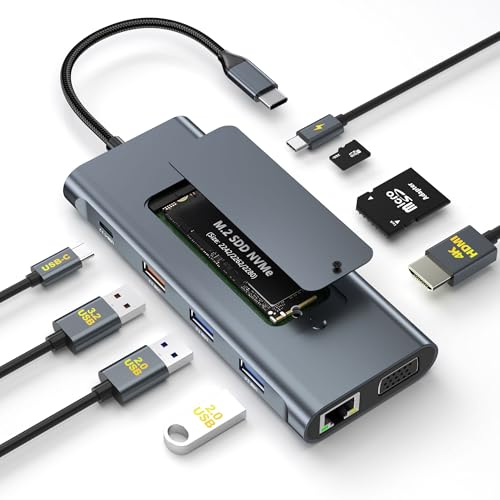
- Up to 2TB NVMe storage support
- HDMI, VGA, Ethernet, USB, and card readers
- Includes heatsink, thermal pad, and installation tools
Best For: USB-C laptop users wanting affordable storage expansion
Compact NVMe Access
ACASIS M.2 NVMe & SATA SSD Dock

- 10Gbps USB-C transfers
- Tool-free NVMe and SATA support
- Aluminum open-air cooling
Best For: Quick single-drive SSD swaps and backups
Everyday Expansion Hub
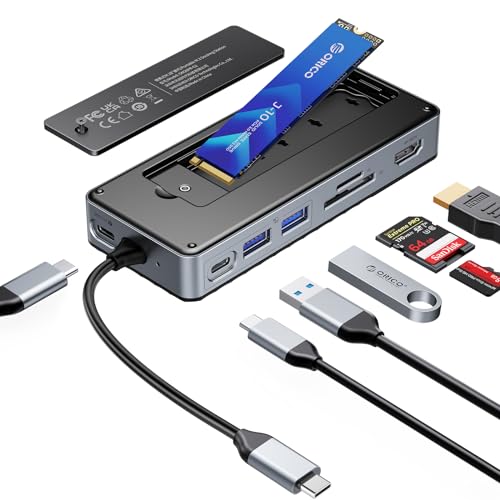
- M.2 NVMe/SATA enclosure
- 4K@60Hz HDMI and 100W PD
- 10Gbps USB and card readers
Best For: Laptop expansion with removable SSD storage
Desktop Storage Powerhouse

- M.2 plus 2.5/3.5-inch drive support
- Dual 4K HDMI outputs
- 10Gbps USB and 100W PD
Best For: Multi-drive workstations and media-heavy setups
Professional Powerhouse – Thunderbolt 5 NVMe Dock
For demanding workflows, this docking station with nvme slot pairs Thunderbolt 5 connectivity with a PCIe Gen 4 x4 M.2 slot, multiple display outputs, fast networking, and extensive peripheral support. It is designed for users handling large creative, engineering, or business files.
Best For: Video editors, photographers, 3D designers, and professionals who need high-speed local storage and multi-monitor capability.
Pros:
- PCIe Gen 4 x4 M.2 slot supports up to 64Gbps transfer rates.
- Supports single 8K@144Hz, dual 8K@60Hz, or triple 4K@144Hz displays under specified conditions.
- Includes 2.5Gb Ethernet, four USB-A ports, SD 4.0, audio, and three downstream Thunderbolt 5 ports.
- Includes a two-year warranty and technical support.
Cons:
- Requires a compatible Thunderbolt 4 or Thunderbolt 5 computer.
- Triple-display support is limited to Windows 11-or-later PCs with Thunderbolt 5; macOS supports dual external displays.
- M.2 SSD, USB-C video cables, and security lock are not included.
This is the most performance-oriented option in the group, especially for creators working with RAW, PSD, or 3D files. Confirm your host and monitor compatibility before buying, and note that the slot accepts only an M-key 2280 SSD.
Compact Value Pick – 9-in-1 USB-C NVMe Dock
This docking station with nvme slot combines portable connectivity with a 10Gbps M.2 NVMe enclosure. It adds 4K@60Hz HDMI, USB ports, card readers, and up to 100W power delivery in a compact aluminum-bodied hub.
Best For: Laptop users who want expandable NVMe storage, everyday peripherals, 4K output, and a travel-friendly design.
Pros:
- Supports M-key PCIe NVMe SSDs up to 4TB.
- Provides USB 3.2 Gen2 connectivity, 4K@60Hz HDMI, and SD/TF card reading.
- Includes an aluminum heatsink, silicone cooling pad, screwdriver, and quick-start guide.
- Supports up to 100W Power Delivery when paired with a suitable adapter.
Cons:
- Power adapter and charging cable are not included.
- The SSD slot does not support SATA M.2 drives.
- SD and TF cards cannot be used simultaneously.
Choose this model when portability and practical expansion matter more than Thunderbolt-level bandwidth. Its included installation accessories make it a convenient way to add NVMe storage, provided your laptop supports USB-C data, charging, and video output.
Windows Creator Choice – USB4 NVMe Dock
This docking station with nvme slot is built around USB4, native DisplayPort Alt Mode, and a high-speed M.2 enclosure. It supports up to 40Gbps USB4 throughput, 20Gbps SSD transfers, 100W power delivery, and demanding display configurations without virtual graphics drivers.
Best For: Windows-based video creators, developers, and technical users who need fast storage, USB4 peripherals, and multiple displays.
Pros:
- Supports an M.2 PCIe NVMe SSD enclosure expandable up to 8TB.
- Offers stated SSD read speeds up to 2004MB/s and write speeds up to 1770.75MB/s.
- Supports one 8K@60Hz display or triple 4K@144Hz displays under compatible conditions.
- Includes two downstream USB4 ports, two DP 2.1 ports, and 100W power delivery.
Cons:
- Not compatible with Mac according to the supplied product notes.
- The host must support DP 2.1 with DSC, USB4, Thunderbolt 4, or Thunderbolt 5 for full functionality.
- The cooling fan produces some noise during normal operation.
This dock makes sense for a Windows workstation that needs fast project storage and serious display expansion in one unit. Its host requirements are demanding, so verify DP, DSC, and USB4 support before purchasing; the SSD is sold separately.
Everyday Expansion Pick – UGREEN Revodok NVMe Dock
For everyday laptop expansion, this docking station with nvme slot adds a 10Gbps M.2 NVMe slot alongside 4K@60Hz HDMI, USB-A and USB-C ports, Gigabit Ethernet, card readers, and 100W charging support.
Best For: MacBook, Mac mini, Windows laptop, iPad Pro, and handheld users who want straightforward storage and peripheral expansion.
Pros:
- Combines an M.2 NVMe slot with ten connectivity options.
- Includes 10Gbps USB-A and USB-C ports for fast file transfers.
- Supports 4K@60Hz HDMI, Gigabit Ethernet, SD/TF readers, and 100W PD charging.
- Designed for plug-and-play use without drivers.
Cons:
- The supplied notes do not specify the maximum supported SSD capacity or display count.
- Full 100W charging requires a compatible power setup.
- The NVMe drive is not stated as included.
This is a balanced choice for users who want one compact hub for storage, displays, networking, and removable media. It offers broad device compatibility and simple setup, while users with unusually high storage or multi-display demands should confirm those specifications before buying.
Best All-in-One Value – 11-in-1 Vertical NVMe Dock
This docking station with nvme slot is a practical choice for MacBook and USB-C laptop users who want storage expansion, display output, wired networking, and card readers in one space-saving unit. Its vertical design also helps reduce desk clutter.
Best For: MacBook users, content creators, and compact workstations needing up to 4TB of added NVMe storage.
Pros:
- Supports M.2 NVMe SSDs up to 4TB in 2230, 2242, 2260, and 2280 sizes.
- Combines 4K@60Hz HDMI, Gigabit Ethernet, SD/TF readers, and multiple USB ports.
- Provides 100W PD input and a vertical design that can double as a laptop stand.
Cons:
- SSD is sold separately.
- Video output requires a compatible USB-C port with DP Alt Mode.
Choose this model when you want broad everyday connectivity without sacrificing storage capacity or desk space. It is especially appealing for photo and video workflows, though you should verify your laptop’s USB-C capabilities before buying.
Best Premium Thunderbolt Option – Maxidok Thunderbolt 5 NVMe Dock
This docking station with nvme slot is designed for demanding Thunderbolt 5 workstations. It pairs a 17-port connection layout with PCIe Gen4x4 NVMe storage support, high-speed networking, and advanced multi-display capabilities.
Best For: Thunderbolt 5 users who need extensive connectivity, high-bandwidth storage, and multi-monitor support.
Pros:
- Built-in M.2 PCIe Gen4x4 slot supports compatible SSDs up to 8TB.
- Offers 17 ports, including Thunderbolt 5, 2.5GbE, DisplayPort, USB, audio, and card readers.
- Supports up to 240W total system power and triple independent displays on Windows.
- Aluminum construction and an AI-controlled cooling fan help manage heavy workloads.
Cons:
- Requires a Thunderbolt 5/4 computer for the stated high-end feature set.
- Mac users need macOS 15 or later, and display support differs from Windows.
- Some SSD heatsinks are incompatible, and the cooling fan can produce noise.
This is the strongest fit for a premium, high-bandwidth desk setup rather than a basic laptop hub. Check SSD heatsink dimensions and your operating system before purchase, particularly if you plan to use multiple displays.
Best Budget Expansion Hub – 11-in-1 USB-C NVMe Dock
This docking station with nvme slot adds up to 2TB of M.2 NVMe storage alongside common laptop expansion ports. It is a compact option for users who want an SSD enclosure, display outputs, card readers, and wired networking without carrying separate accessories.
Best For: USB-C laptop users seeking affordable storage expansion and flexible dual-display connectivity.
Pros:
- Accepts an M.2 NVMe SSD up to 2TB and supports 10Gbps read/write performance.
- Includes 4K HDMI, VGA, Gigabit Ethernet, SD/TF readers, and USB ports.
- Provides 100W PD passthrough and includes a screwdriver, thermal pad, and heatsink.
- HDMI and VGA can support simultaneous extended or mirrored displays.
Cons:
- Does not support M.2 SATA SSDs, and the SSD is not included.
- HDMI output is limited to 4K@30Hz.
- Requires a fully featured USB-C or Thunderbolt 3 port for charging, data, and video.
Consider this model when storage expansion and port variety matter more than 4K@60Hz performance. Its included cooling accessories make SSD installation more approachable, but compatibility and display-port limitations should be checked first.
Compact NVMe Access – ACASIS M.2 NVMe & SATA SSD Dock
If you need a straightforward docking station with nvme slot for quick drive swaps, the ACASIS focuses on tool-free access and 10Gbps USB-C transfers. Its open toaster-style layout and aluminum construction also help with airflow during use.
Best For: Users who want a compact reader for M.2 NVMe or SATA SSDs rather than a full laptop port hub.
Pros:
- Supports M.2 NVMe and SATA drives in 2230, 2242, 2260, and 2280 sizes.
- Offers USB 3.2 transfer speeds up to 10Gbps for backups and large files.
- Tool-free, driver-free design makes SSD installation and removal simple.
- Aluminum body and open design promote heat dissipation.
Cons:
- Supports only one drive at a time.
- It is an SSD reader/enclosure, not a multi-port laptop docking station with display or charging outputs.
The ACASIS is a practical choice when easy M.2 access matters more than extra connectivity. It supports up to 8TB according to the supplied specifications and includes a USB-C to USB-C/A cable.
Everyday Expansion Hub – ORICO 8-in-1 NVMe Dock
The ORICO combines a docking station with nvme slot and everyday laptop expansion in one compact unit. Along with an M.2 NVMe/SATA enclosure, it provides 4K@60Hz HDMI, USB ports, card readers, and 100W power delivery input.
Best For: Laptop users who need external SSD storage plus display, peripheral, and memory-card connectivity.
Pros:
- Combines an M.2 NVMe/SATA enclosure with an eight-interface USB-C hub.
- Supports USB 3.2 Gen 2 transfers up to 10Gbps and HDMI output up to 4K@60Hz.
- Includes a dedicated 100W PD port for laptop charging.
- Includes a heatsink, silicone cooling pad, screwdrivers, and USB-C cable.
Cons:
- Power adapter and charging cable are not included.
- SD and TF cards cannot be used simultaneously.
- HDMI requires a host USB-C port that supports video transmission.
This ORICO model is a balanced option for a desk or travel setup that needs both fast removable storage and common laptop-dock features. The SSD is not included, so plan for a separate M.2 drive.
Desktop Storage Powerhouse – YOTUO 16-in-1 Dual-Drive Dock
For a desktop-style docking station with nvme slot, the YOTUO offers unusually broad storage and connectivity options. It accepts an M.2 NVMe/SATA SSD and a separate 2.5- or 3.5-inch SATA drive, while adding dual HDMI, Ethernet, card readers, audio, and multiple USB ports.
Best For: Power users managing multiple drives, dual displays, large media libraries, or backup workloads.
Pros:
- Supports both M.2 NVMe/SATA storage and 2.5/3.5-inch SATA HDDs or SSDs.
- Provides dual 4K HDMI outputs, with Windows and macOS support noted.
- Includes 10Gbps USB-C data, 100W PD, Gigabit Ethernet, SD/TF readers, and audio.
- Built-in fan and vertical stand support cooling and desk-space efficiency.
Cons:
- 3.5-inch and 2.5-inch SATA drives require the included 12V power adapter.
- The M.2 drive is not hot-swappable and must be disconnected before removal.
- Apple Silicon Macs support only one extended external display; the second mirrors.
The YOTUO is the most capable option here for a permanent workstation, especially when dual-drive access and broad I/O are priorities. Its larger footprint, external power requirement, and cooling fan make it less suited to a minimal travel setup.
How We Picked the Best Docking Station with Nvme Slot
We selected products across several use cases, including everyday laptop expansion, high-speed NVMe storage, multi-monitor workstations, desktop-replacement setups, and mixed NVMe/SATA support. We compared the advertised interface standard, port selection, display capabilities, power-delivery rating, storage format compatibility, and overall flexibility.
Because performance depends on the computer, cable, SSD, and operating system, advertised maximum speeds should be treated as best-case figures. A Thunderbolt or USB4 host can provide more bandwidth than standard USB-C, but the dock cannot exceed the capabilities of the connected laptop.
Quick Comparison
- Best for maximum bandwidth: Thunderbolt 5 and USB4 models are suited to fast external storage, high-resolution displays, and demanding peripherals.
- Best for general laptop expansion: 9-in-1 to 11-in-1 USB-C docks typically balance HDMI, USB, card readers, Ethernet, charging, and an M.2 bay.
- Best for large storage setups: Models supporting both NVMe and SATA drives—or 2.5- and 3.5-inch drives—offer broader upgrade flexibility.
- Best for portability: Compact hub-style designs are easier to carry, though they may provide fewer ports and less cooling capacity.
Key Buying Factors for a Docking Station with Nvme Slot
Host Interface and Bandwidth
Check whether your laptop has USB-C, USB 3.x, USB4, or Thunderbolt. A fast NVMe enclosure is most useful when the host connection supports sufficient bandwidth. Thunderbolt 5 and USB4 models are generally the strongest choices for demanding storage and display workloads.
SSD Compatibility and Installation
Confirm the dock’s supported M.2 key type, length, and protocol. Some products accept NVMe drives only, while others also support SATA M.2 SSDs. Look for tool-free installation, a secure cover, and a heatsink or ventilation if you expect sustained transfers.
Displays, Ports, and Charging
Verify the exact resolution and refresh rate supported by your computer and operating system. Also count the ports you will use simultaneously: USB-A, USB-C, HDMI, DisplayPort, Ethernet, SD, and microSD. Power Delivery ratings describe the dock’s input capacity; the laptop may receive less after power is allocated to connected devices.
Thermals and Reliability
NVMe drives can slow down when hot, particularly during large file copies or video work. A metal enclosure, thermal pad, ventilation, and sensible placement can help. For permanent workstations, prioritize stable power, reputable firmware support, and a sufficiently long host cable.
Who Should Buy Which Docking Station with Nvme Slot?
Choose a Thunderbolt 5 dock if you want maximum connectivity for a modern professional laptop and plan to run fast storage or multiple displays. A USB4 model is a strong middle ground for compatible systems. For typical office, school, and home use, a USB-C dock with 4K HDMI, card readers, Ethernet, and 100W-class charging may offer the best balance.
Pick a dual-protocol NVMe/SATA model if you already own older M.2 drives or want easier storage reuse. If you need desktop-sized 2.5- or 3.5-inch drives, choose the larger multi-drive enclosure rather than a compact docking station with an NVMe slot. Finally, confirm your laptop’s charging, display, and USB-C specifications before ordering; those details determine whether the dock delivers the advertised experience.