The right motorized slider can turn a basic tripod setup into a repeatable camera move. Adding pan-tilt control expands that range, helping you keep a subject centered, create panoramic motion, or automate complex shots.
We selected 10 options spanning compact portable sliders, long-rail systems, motorized tripod heads, and app-controlled rigs. Use the guide below to match travel needs, payload, control options, and shooting style to the right setup.
Best 10 Camera Sliders with Pan Tilt Picks for 2026
Best Smart Tracking Slider
IFOOTAGE Shark Slider Nano II-660

- AI face and object tracking
- Up to 7.7-pound payload
- App and touchscreen programming
Best For: Solo creators and automated cinematic shots
Best Compact Manual Dolly
NEEWER SD001 Camera Slider Dolly

- Linear or circular wheel movement
- 360-degree rotation and 90-degree tilt
- Lightweight 220-gram design
Best For: Phones, tabletop videos, and lightweight cameras
Best Heavy-Duty Pan-Tilt Head
Soonpho M8 Motorized Pan Tilt Head

- Supports up to 7.7 pounds
- 35-meter wireless remote range
- A/B points and auto-rotation modes
Best For: Heavier camera rigs needing remote pan and tilt
Best Long Motorized Track
GVM 48-Inch Motorized Camera Slider
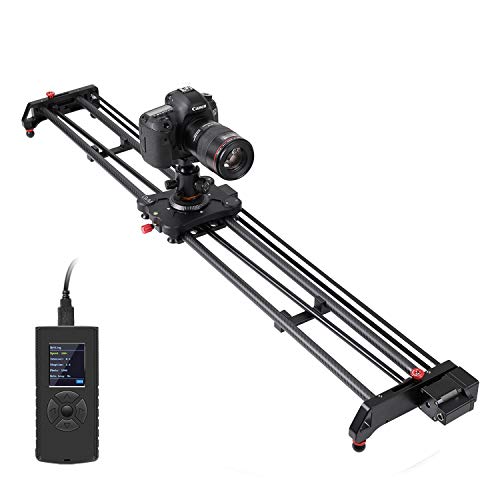
- 48-inch (120cm) carbon-fiber track
- Automatic round-trip operation
- Time-lapse and panoramic shooting modes
Best For: Long tracking moves and time-lapse production
Best Face-Tracking Pan Tilt Head

- 360° rotation with ±25° tilt
- Auto face and body tracking
- 8–10-hour battery with remote control
Best For: Solo filming, livestreaming, and interviews
Best Pro Slider for Multi-Axis Motion

- 34-inch motorized slider with 360° pan
- Supports DJI gimbal integration
- App control, AI tracking, and eight waypoints
Best For: Professional multi-axis filming and live production
Best Budget Remote Pan Tilt Head

- 360° pan with 50° tilt adjustment
- 30-meter wireless remote range
- 8–10-hour battery and A/B presets
Best For: Lightweight camera, phone, and livestreaming setups
Best Compact Pick
IFOOTAGE PICO Motorized Camera Slider

- 15.8-inch portable motorized slider
- 360° pan with app control
- Designed for lightweight creator rigs
Best For: Travel, tabletop filming, DJI Pocket 3, and solo creators
Best Long-Rail Value
NEEWER ER1 31.5-Inch Motorized Slider

- 31.5-inch carbon-fiber rail
- 11-pound horizontal load capacity
- App control and 45° tilt support
Best For: Product videos, time-lapse, and tripod-based shooting
Best for Controlled Motion
NEEWER ER1-80 App-Controlled Slider

- Programmable app-controlled movement
- Silent motor with 45° tilt support
- Includes 4400mAh NP-F750 battery
Best For: Repeatable tracking shots, video, and time-lapse
Best Smart Tracking Slider – IFOOTAGE Shark Slider Nano II-660
If you want camera sliders with pan tilt control, the IFOOTAGE Shark Slider Nano II-660 is a highly capable motorized option. It combines programmable sliding with AI face and object tracking, and it can add pan, tilt, and roll control when paired with compatible DJI RS stabilizers.
Best For: Solo creators, time-lapse work, product photography, and complex moving shots that benefit from automated tracking.
Pros:
- Offers precise motorized movement with 0.01mm positioning accuracy and a 7.7-pound payload.
- Supports AI face and object tracking, with expanded multi-axis control when used with compatible DJI RS stabilizers.
- Provides app and touchscreen control, up to eight keyframes, six shooting modes, and quiet operation below 20dB.
Cons:
- Full pan, tilt, roll, and slide tracking requires a compatible DJI RS stabilizer.
- Its advanced feature set may be more than needed for simple manual sliding shots.
The Nano II-660 is the most feature-rich choice here for automated, repeatable camera movement. Its quiet carbon-fiber build and fast charging add practical value for production environments.
Best Compact Manual Dolly – NEEWER SD001 Camera Slider Dolly
The NEEWER SD001 is a pocket-sized manual dolly for simple sliding and panning shots. Its adjustable wheels support straight or circular movement, while the included ball head adds 360-degree rotation and 90-degree tilt for basic pan tilt setups.
Best For: Smartphone creators, tabletop product videos, mirrorless cameras, and lightweight outdoor shooting setups.
Pros:
- Compact 220-gram aluminum design is easy to carry.
- Adjustable wheels enable linear or circular movement for sliding and panoramic shots.
- Includes a 360-degree rotating, 90-degree tilting ball head and a rotatable phone clamp with cold shoe.
Cons:
- Manual operation does not provide automated or motorized movement.
- Not suitable for telephoto lenses.
- Its maximum recommended load is 6.6 pounds, so heavier rigs may be unsuitable.
This is a practical low-cost option when portability matters more than automation. The pan tilt ball head and phone support make it especially useful for tabletop and mobile content.
Best Heavy-Duty Pan-Tilt Head – Soonpho M8 Motorized Pan Tilt Head
The Soonpho M8 is a motorized pan tilt head rather than a conventional slider, making it a useful addition to camera sliders with pan tilt workflows. It supports up to 3.5kg and provides remote-controlled horizontal and vertical movement for controlled tripod or slider-mounted shots.
Best For: Videographers needing remote pan and tilt control for heavier DSLR, mirrorless, or camcorder rigs.
Pros:
- Supports loads up to 3.5kg (7.7 pounds) with a stable aluminum construction.
- Offers eight joystick speed levels, fast and slow modes, and adjustable pan and tilt speeds.
- Includes 35-meter wireless control, A/B waypoints, scanning, auto-rotation, and an Arca Swiss quick-release plate.
Cons:
- It provides pan and tilt movement but is not itself a sliding rail or dolly.
- Battery operation requires NP-F550/750 batteries unless using USB-C PD power.
The M8 is a strong choice when pan tilt control is the priority and your setup needs to handle a substantial camera rig. Its waypoint and scanning functions make repeatable movements easier without a dedicated operator beside the camera.
Best Long Motorized Track – GVM 48-Inch Motorized Camera Slider
The GVM 48-inch motorized slider is built for longer tracking moves, time-lapse sequences, and panoramic video. Its carbon-fiber rail supports manual or electric operation, while adjustable knobs allow the carriage to follow a curved path for panning-style movement.
Best For: Longer lateral camera moves, time-lapse production, panoramic shots, and setups that need broad 120cm travel.
Pros:
- Provides a 48-inch (120cm) track for extended camera movement.
- Supports automatic round trips, time-lapse settings, adjustable speed, interval, stop time, and photo count.
- Includes adjustable feet, multiple 1/4-inch and 3/8-inch mounting ports, a battery, remote, cables, and carrying bag.
Cons:
- The 48-inch slider is relatively bulky at 11.8 pounds and is not especially portable.
- Its pan-style movement is created by adjusting the carriage knobs rather than dedicated motorized pan and tilt axes.
- It is not water resistant.
Choose the GVM when travel distance and programmed sliding matter most. It offers a substantial rail and useful time-lapse controls, but users seeking integrated motorized pan tilt should consider pairing it with a compatible head.
Best Face-Tracking Pan Tilt Head – Soonpho M6
If you want camera sliders with pan tilt capabilities but primarily need automated subject framing, the Soonpho M6 is a practical motorized tripod-head option. It combines 360° horizontal rotation, ±25° tilt adjustment, face and body tracking, and gesture controls for solo filming.
Best For: Solo creators, livestreamers, interview recording, and outdoor shooting with a camera, camcorder, or smartphone.
Pros:
- Tracks faces and human bodies without requiring an app or Bluetooth connection.
- Provides 360° rotation and ±25° tilt adjustment with eight speed levels.
- Offers A/B angle presets, remote control, and an 8–10-hour built-in battery.
- Includes a phone holder and supports cameras up to 5 pounds.
Cons:
- It is a rotating pan-tilt head rather than a linear camera slider.
- It is not water resistant.
- The listed tilt range is ±25°, which may be limiting for some steep-angle shots.
The M6 stands out when hands-free tracking matters more than linear slider movement. Its gesture controls, presets, and long battery life make it especially convenient for solo presenters and mobile production setups.
Best Pro Slider for Multi-Axis Motion – IFOOTAGE Shark Nano II 860
For buyers specifically seeking camera sliders with pan tilt movement, the IFOOTAGE Shark Nano II 860 is the most feature-rich option here. Its 34-inch motorized slider supports 360° unlimited pan movement and can integrate with compatible DJI gimbals for synchronized slider, pan, and stabilization motion.
Best For: Professional filmmaking, live streaming, interviews, product demonstrations, and advanced multi-axis camera movement.
Pros:
- Combines slider travel with 360° pan movement and dual-axis motorized control.
- Supports up to 5 kg horizontally and 2.5 kg vertically, according to the supplied specifications.
- Offers touchscreen and smartphone-app control, eight waypoints, speed adjustment, and time-lapse settings.
- Includes AI face/object tracking and multi-target presets for up to four points.
Cons:
- DJI gimbal integration requires a compatible adapter, and the gimbal is sold separately.
- Its advanced multi-axis feature set may be more than casual users need.
- It requires a 60W-or-higher power supply for DJI integration.
The Nano II 860 is the strongest match for demanding pan-and-slide shots. Its app control, waypoint programming, tracking, and DJI compatibility make it suited to repeatable cinematic moves rather than simple tripod-head panning.
Best Budget Remote Pan Tilt Head – Soonpho M2
The Soonpho M2 is a straightforward choice for camera sliders with pan tilt shoppers who need remote motorized panning and tilting without a full multi-axis slider system. It rotates 360°, tilts through a 50° range, and mounts to tripods, light stands, or monopods using standard 1/4-inch connections.
Best For: Remote-controlled panoramas, livestreaming, interviews, sports-field filming, and smartphone or camera setups.
Pros:
- Provides 360° horizontal rotation and 50° tilt adjustment with seven speed levels.
- Includes a wireless remote with up to 30 meters of control range.
- Supports A/B angle presets for repeatable moves between two positions.
- Has a 2000mAh built-in battery rated for about 8–10 hours and USB-C charging.
Cons:
- It is a pan-tilt tripod head, not a linear slider.
- Its maximum recommended load is 1 kg.
- It lacks the M6’s automatic face and body tracking.
The M2 offers useful remote motion control in a compact format. It is a sensible fit for lighter camera or phone rigs when you want programmable pan-and-tilt movement rather than a longer slider rail.
Best Compact Pick – IFOOTAGE PICO Motorized Camera Slider
For creators seeking compact camera sliders with pan tilt capability, the IFOOTAGE PICO combines a 15.8-inch motorized slider with 360° panning. Its small footprint and app control make it practical for travel, tabletop filming, product shots, and solo video production.
Best For: DJI Pocket 3 users, lightweight camera setups, desktop studios, and travel-friendly cinematic shots.
Pros:
- Compact 15.8-inch design is easy to carry and use in small spaces.
- Combines motorized linear movement with 360° panning.
- App control supports repeatable video, time-lapse, stop-motion, panorama, and multi-point moves.
- Compatible with DJI Pocket 3, action cameras, smartphones, and lightweight mirrorless cameras.
Cons:
- Its compact format is better suited to lightweight rigs than large camera setups.
- The supplied notes do not specify a maximum payload.
The PICO is a strong choice when portability and pan capability matter more than a long travel distance or heavy-duty capacity. It is especially convenient for solo creators who want controlled movement without carrying a full-size slider.
Best Long-Rail Value – NEEWER ER1 31.5-Inch Motorized Slider
The NEEWER ER1 provides a longer 31.5-inch rail for smoother tracking shots and supports pan-and-tilt-style positioning through adjustable side knobs and 45° tilt shooting. App control, optional 2.4G remote control, and time-lapse modes add flexibility for product work and video production.
Best For: Creators who need a longer travel distance, tripod mounting, and motorized movement for video or time-lapse work.
Pros:
- 31.5-inch rail provides more travel than compact desktop sliders.
- Supports up to 11 pounds horizontally and 5.5 pounds when tilted up 45°.
- Offers app and optional 2.4G remote control, plus manual, video, and time-lapse modes.
- Carbon-fiber construction, four roller bearings, and tripod threads support stable setups.
Cons:
- 2.4G remote control is not included.
- Charger is not included, and the unit weighs 8.7 pounds.
- The notes caution that minor shake may occur during macro photography.
This ER1 is a practical option for buyers who want a substantial rail and useful payload capacity without stepping up to a larger production system. Its tilt support and adjustable angles make it more versatile than a slider limited to straight horizontal moves.
Best for Controlled Motion – NEEWER ER1-80 App-Controlled Slider
The NEEWER ER1-80 is a 31.5-inch motorized camera slider for controlled tracking, panorama, and tilt shots. Its app wireless control, silent stepper motor, programmable motion settings, and 45° tilt support make it a capable choice for repeatable camera movement.
Best For: DSLR and phone users who want programmable video or time-lapse motion with a longer carbon-fiber rail.
Pros:
- Supports up to 11 pounds horizontally and 5.5 pounds at a 45° tilt.
- App control offers constant speed, slow start/stop, frame, interval, and exposure adjustments.
- Silent stepper motor is designed for smooth, quiet movement.
- Includes a 4400mAh NP-F750 battery and provides 1/4-inch and 3/8-inch mounting threads.
Cons:
- Battery charger and portable power source are not included.
- The slider weighs 8.7 pounds, making it less convenient for lightweight travel kits.
- It is not water resistant.
Choose this version when precise, repeatable motion is a priority. It offers the same useful long-rail format and angle flexibility as a traditional production slider, while app settings make complex video and time-lapse moves easier to reproduce.
How We Picked the Best Camera Sliders with Pan Tilt
We focused on systems that support controlled camera movement rather than judging length alone. The selection includes motorized sliders, rotating pan-tilt heads, and combination setups suitable for DSLR, mirrorless, action-camera, and smartphone work. We considered rail length, payload suitability, portability, control methods, repeatability, power options, and features such as time-lapse programming, app control, face tracking, and automatic round trips.
Because these products serve different roles, a compact pan-tilt head is not a direct substitute for a long slider rail. Check the product specifications carefully before assuming that a listed kit includes every clamp, mounting plate, battery, or support needed for your camera.
Quick Comparison
- Best for compact travel: Look at portable sliders and small motorized heads that pack easily and work with phones or lightweight cameras.
- Best for longer tracking shots: Choose a 31.5-inch, 34-inch, 48-inch, or 26-inch rail according to the camera move and available support space.
- Best for automated moves: Prioritize app control, programmable speed, time-lapse functions, and repeatable motion.
- Best for subject-following shots: Face tracking and pan-tilt movement can help keep a presenter or performer in frame.
- Best for simple setups: A manual dolly or standalone rotating head may be easier to operate than a fully motorized slider.
Key Buying Factors for Camera Sliders with Pan-Tilt
Rail Length and Usable Travel
A longer rail creates broader tracking moves, but it adds weight and demands more room. Shorter sliders are easier to pack and position on a desk, tabletop, or small set. Remember that advertised rail length may exceed the actual motorized travel.
Payload and Balance
Compare the combined weight of the camera, lens, cage, microphone, battery, and any mounted accessories with the slider’s stated capacity. Pan-tilt movement places additional demands on the motor and requires a balanced setup, especially with longer lenses.
Control and Repeatability
App, remote, touchscreen, and onboard controls each suit different workflows. Programmable speed and repeatable paths matter for product videos and time-lapse work, while manual controls may be faster for spontaneous shooting. Confirm phone compatibility and whether the app is required.
Power, Noise, and Support
Check battery type, charging method, operating time, and whether a charger is included. Motor noise can matter for interviews and quiet locations. A long slider may need two tripods or sturdy supports, while a pan-tilt head still needs a stable tripod.
Who Should Buy Which Camera Sliders with Pan Tilt?
Traveling creators and smartphone filmmakers should favor compact systems with phone clamps, lightweight construction, and straightforward remote or app control. Product reviewers and commercial shooters will benefit from programmable motion, repeatability, and enough payload capacity for a full camera rig. Interview and presentation shooters should consider face tracking or pan-tilt automation to maintain framing as the subject moves. Landscape and time-lapse users should prioritize long battery life, smooth low-speed motion, and reliable interval programming. If you only need occasional lateral movement and prefer maximum simplicity, a manual dolly may be the better value.