Finding the right USB hub means balancing port speed, capacity, power delivery, and the devices you actually use. The models in this roundup cover compact laptop expansion, high-port desktop setups, charging-focused designs, and powered hubs for demanding peripherals.
Although many listings use USB 3.2 branding and advertise speeds up to 10Gbps, this guide helps you evaluate real-world compatibility and choose the best fit for your workflow.
Best 10 USB Hub with 20gbps Ports Picks for 2026
Best High-Capacity Pick
VANGREE 17-Port Powered USB Hub

- 17 ports with USB-A, USB-C, SD, and TF access
- Ten data ports support up to 10Gbps
- 96W power adapter plus three 24W QC ports
Best For: Large desktop setups needing many connections and card readers
Best Professional USB-C Hub

- Eight USB-A and two USB-C downstream ports
- 65W self-powered design with included adapter
- Locking USB-C cable and optional mounting support
Best For: Office and IT setups requiring secure, powered USB expansion
Best Port-Control Pick
VANGREE 16-Port USB-C and USB-A Hub

- Eight USB-A and eight USB-C ports
- Individual switches for every port
- 96W powered design with up to 10Gbps transfers
Best For: Multi-device workstations needing convenient peripheral control
Best Compact USB-C Pick

- Four USB-C ports rated up to 10Gbps each
- Up to 100W pass-through charging
- Compact design with audio support
Best For: Portable USB-C setups needing fast data and charging
Best for Maximum Port Count
ACASIS 16-Port Powered USB 3.2 Hub
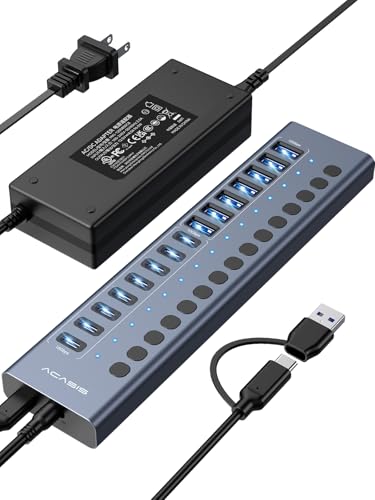
- 16 total USB-A and USB-C ports
- 96W adapter for powered operation
- Individual switches and aluminum housing
Best For: Large desktop setups with many peripherals
Best Hybrid Charging Hub

- Three data ports support up to 10Gbps
- Two dedicated 45W USB-C charging ports
- Includes a 65W power adapter
Best For: USB-C laptops needing data and device charging
Best Compact Option
ORICO 4-Port Zinc Alloy USB 3.2 Hub

- Two USB-A and two USB-C ports
- Up to 10Gbps shared bandwidth
- Compact zinc alloy, plug-and-play design
Best For: Portable everyday laptop connectivity
Best Powered 15-in-1
High-Capacity 10Gbps USB-C Hub

- 15 total ports with USB-C and USB-A connections
- Powered design with 100W PD input
- Angled aluminum housing with non-slip feet
Best For: Large desktop setups needing many powered connections
Best All-USB-C Layout

- Four USB-C and three USB-A 3.2 ports
- 10Gbps data transfer on every port
- Individual switches with LED indicators
Best For: USB-C-heavy workstations needing powered data expansion
Best Mixed-Port Value

- Two USB-C 3.2 and one USB-A 3.2 port
- Four additional USB-A 3.0 connections
- Individual switches and powered operation
Best For: Mixed USB-A and USB-C peripheral collections
Best High-Capacity Pick – VANGREE 17-Port Powered USB Hub
If you need a USB hub with 20Gbps ports, note that this VANGREE model is rated up to 10Gbps rather than 20Gbps. Its 17-port layout, external power supply, card readers, and charging ports make it a practical choice for a busy desktop setup.
Best For: Users who need many USB-A connections, card-reader access, and separate charging ports in one powered hub.
Pros:
- Provides 17 total ports, including USB-A, USB-C, SD, and TF connections.
- Ten USB-A data ports support transfers up to 10Gbps.
- Includes a 96W UL-certified power adapter and three 24W QC charging ports.
- SD and TF cards can be read simultaneously.
Cons:
- It does not provide 20Gbps ports; listed data speeds top out at 10Gbps.
- The three QC charging ports do not support data transmission.
This is a strong expansion option for desktops, drives, flash media, and card-based workflows. Choose it for port quantity and charging flexibility rather than maximum USB 20Gbps performance.
Best Professional USB-C Hub – StarTech 10-Port 10Gbps Hub
For shoppers comparing a USB hub with 20Gbps ports, this StarTech model offers 10Gbps USB 3.2 Gen 2 performance instead. It focuses on dependable USB-C expansion, powered operation, and features suited to office or IT environments.
Best For: USB-C laptops and desktops that need a professionally oriented, self-powered hub with both USB-A and USB-C ports.
Pros:
- Offers eight USB-A and two USB-C downstream ports.
- Includes a 65W power adapter to support specified port power.
- USB-IF-certified locking USB-C host cable helps maintain a secure connection.
- Supports desk, wall, and VESA mounting with optional accessories.
Cons:
- It is rated at 10Gbps, not 20Gbps.
- Mounting accessories are sold separately.
Overcurrent protection, wake-on-USB support, and optional security software make this a sensible fit for managed workspaces. It is less compelling if you only want the highest possible transfer rate or a compact travel dongle.
Best Port-Control Pick – VANGREE 16-Port USB-C and USB-A Hub
This powered VANGREE hub is worth considering when you want extensive USB-C and USB-A expansion, though it is not a USB hub with 20Gbps ports. All 16 ports are specified for up to 10Gbps and include individual switches for convenient peripheral control.
Best For: Users managing many USB peripherals who want separate on/off control without repeatedly unplugging devices.
Pros:
- Combines eight USB-A and eight USB-C 3.2 ports.
- Supports up to 10Gbps data transfer and backward compatibility with older USB devices.
- Individual switches and blue status indicators simplify device management.
- Includes a 96W UL-certified power adapter and built-in protection features.
Cons:
- It does not offer 20Gbps ports.
- USB-C ports do not support DisplayPort or display extension.
- Listed warranty coverage is one year.
The balanced USB-A/USB-C layout is useful for a mixed peripheral collection, while independent switches add practical convenience. Avoid it if video output or USB 20Gbps performance is essential.
Best Compact USB-C Pick – Belkin 4-Port 100W Hub
If portability matters more than a large port count, this Belkin model is a compact alternative to a USB hub with 20Gbps ports. Its four USB-C 3.2 Gen 2 ports reach up to 10Gbps and support pass-through charging up to 100W.
Best For: Mac, Windows, and Chrome devices that need a small all-USB-C expansion hub with charging support.
Pros:
- Provides four USB-C 3.2 Gen 2 ports with up to 10Gbps transfer speeds each.
- Supports up to 100W pass-through charging.
- Compact, lightweight design suits portable setups.
- Supports audio devices such as headphones, speakers, and audio interfaces.
Cons:
- It offers 10Gbps performance, not 20Gbps.
- All four expansion ports are USB-C, with no USB-A, card-reader, or video-output ports listed.
- Its four-port design provides less expansion than the larger powered hubs.
This is the most travel-friendly option in the group and a good match for newer USB-C systems. Its limited port variety makes it better for focused accessory expansion than a full desktop dock replacement.
Best for Maximum Port Count – ACASIS 16-Port Powered USB 3.2 Hub
If you need a USB hub with 20Gbps ports, this ACASIS model is worth evaluating for its unusually high port count, though its listed USB 3.2 interfaces reach 10Gbps rather than 20Gbps. It provides eight USB-A and eight USB-C data ports, individual switches, and a 96W power adapter for managing multiple peripherals.
Best For: Desktop users who need many USB-A and USB-C connections at once.
Pros:
- Sixteen total ports: eight USB-A and eight USB-C.
- 96W power adapter supports multiple connected devices.
- Individual on/off switches simplify port management.
- Aluminum housing is designed for heat dissipation and durability.
Cons:
- Ports are rated at 10Gbps, not 20Gbps.
- Does not support video output.
- Its larger 16-port design is less travel-friendly.
The ACASIS is a strong choice when connectivity and centralized power matter more than maximum per-port speed. Its powered design and individual switches make it practical for a busy workstation, but shoppers specifically requiring 20Gbps should look elsewhere.
Best Hybrid Charging Hub – Powered 9-Port USB 3.2 Hub
For shoppers comparing a USB hub with 20Gbps ports, this powered hybrid model offers up to 10Gbps data connections plus dedicated charging ports. Its nine-port layout combines USB-A, USB-C, slower USB-A 3.0 ports, and two USB-C PD ports that are intended for charging rather than data transfer.
Best For: USB-C laptop users who want mixed peripheral connectivity and dedicated phone or tablet charging.
Pros:
- Includes one USB-C and two USB-A 10Gbps data ports.
- Two USB-C PD ports provide up to 45W charging.
- 65W power adapter helps stabilize connected devices.
- Angled aluminum design is made for desktop use.
Cons:
- Data ports are rated up to 10Gbps, not 20Gbps.
- PD charging ports do not support data transmission.
- Not recommended for charging computers or other high-power devices.
This hub is more versatile than a basic splitter because it separates data and charging duties. It is a sensible desk accessory for a USB-C laptop, but users transferring from multiple SSDs or seeking true 20Gbps performance should note the stated limitations.
Best Compact Option – ORICO 4-Port Zinc Alloy USB 3.2 Hub
If portability is your priority when shopping for a USB hub with 20Gbps ports, the ORICO is a compact alternative. Its four USB 3.2 ports—two USB-A and two USB-C—support up to 10Gbps shared bandwidth, making it suitable for everyday peripherals and file transfers without requiring external power.
Best For: Travelers and laptop users who need a small mix of USB-A and USB-C data ports.
Pros:
- Provides two USB-A and two USB-C ports.
- Supports up to 10Gbps shared bandwidth.
- Compact zinc alloy design measures 2.24 by 2.24 by 0.81 inches.
- Plug-and-play setup requires no driver installation.
Cons:
- Supports 10Gbps, not 20Gbps.
- Total bandwidth is shared across the four interfaces.
- Offers fewer ports and no powered charging adapter.
The ORICO is the most portable choice in this group and gives you a balanced selection of USB-A and USB-C connections. It works well for mice, flash drives, phones, and similar accessories, but it is not designed for high-demand multi-drive setups or true 20Gbps transfers.
Best Powered 15-in-1 – High-Capacity 10Gbps USB-C Hub
If you need a USB hub with 20Gbps ports, this powered 15-in-1 model is worth considering for its broad port selection and 10Gbps USB 3.2 connectivity. It includes USB-C and USB-A data ports, dedicated charging connections, and a 100W USB-C PD input for a busy desk setup.
Best For: Creators, photographers, video editors, remote workers, and students who need many connections and external power.
Pros:
- Provides 15 total connections, including USB-C and USB-A data ports.
- Offers 10Gbps data transfer on its USB 3.2 ports.
- Includes a 65W power adapter and supports up to 100W USB-C PD input.
- Angled aluminum construction and non-slip feet suit a stable desktop workspace.
Cons:
- Its ports do not support video output.
- The included 65W adapter must be connected for the hub to work.
- The additional USB-C charging ports are not recommended for computers or other high-power appliances.
This is the most versatile option here for users who prioritize port count, charging flexibility, and a powered desktop design. Just note that its fastest listed data connections are 10Gbps rather than 20Gbps, and display output is not supported.
Best All-USB-C Layout – 7-Port 10Gbps Powered Hub
For shoppers comparing a USB hub with 20Gbps ports, this Rosonway model provides a simpler seven-port layout with 10Gbps performance on every port. Four USB-C and three USB-A 3.2 connections make it particularly useful when most of your peripherals use newer USB-C connectors.
Best For: USB-C-heavy laptop, desktop, and gaming-console workstations that need powered data expansion.
Pros:
- All seven ports support data transfer speeds up to 10Gbps.
- Four USB-C and three USB-A ports provide a flexible hybrid layout.
- Includes a 36W power adapter for stable operation with multiple devices.
- Individual switches and blue LED indicators simplify port-level power control.
Cons:
- USB-C ports support data and standard 1.5A charging only.
- It does not support PD charging or video output.
- Its port count is lower than the 15-in-1 alternative.
This hub is a strong fit when consistent 10Gbps data performance matters more than charging or display features. The detachable 3.3-foot cable and aluminum enclosure also make it practical for home, office, or compact travel setups.
Best Mixed-Port Value – 7-Port USB-A and USB-C Hub
This Rosonway model is a practical choice for shoppers seeking a USB hub with 20Gbps ports while working with a mix of newer and older peripherals. It combines USB-A and USB-C 3.2 connections with four USB-A 3.0 ports, plus a powered design and individual port switches.
Best For: Laptop and desktop users who need both 10Gbps ports and several everyday USB-A connections.
Pros:
- Combines one USB-A 3.2, two USB-C 3.2, and four USB-A 3.0 ports.
- Provides up to 10Gbps transfer speeds on its USB 3.2 connections.
- Includes a 24W UL-certified power supply for stable multi-device use.
- Two-in-one USB-A/USB-C host cable supports a broad range of systems.
Cons:
- Not every port is a 10Gbps USB 3.2 connection; four are USB-A 3.0.
- It does not list video output or USB-C PD charging support.
- The 24W power supply provides less power than the first two options.
This is the most convenient option for mixed peripheral collections, especially if you still use multiple USB-A accessories. Its individual switches and surge protection add useful control, while the two-in-one host cable helps with USB-A and USB-C computers.
How We Picked the Best USB Hub with 20gbps Ports
We compared these hubs by port count, USB-A and USB-C mix, advertised transfer speed, external power support, charging capability, build quality, cable length, and everyday versatility. We also considered whether each design is better suited to travel, a laptop workstation, creative file transfers, or a desk with many always-connected accessories.
One important clarification: several products in this roundup are marketed at up to 10Gbps rather than 20Gbps. USB standards and retailer descriptions are not always consistent, so verify the exact controller speed and host-device requirements before buying a USB Hub with 20gbps Ports.
Quick Comparison
| Priority | Look For | Best Fit |
|---|---|---|
| Maximum port capacity | Powered 15- to 17-port designs | Desktops and studios |
| Balanced expansion | Several USB-C and USB-A data ports | Modern laptops and mixed setups |
| Portability | Compact aluminum hub with a short cable | Travel and hot desks |
| Charging | PD input or dedicated high-output charging ports | Users charging laptops and accessories |
| Device control | Individual power switches | Frequent peripheral swapping |
Key Buying Factors for a USB Hub with 20gbps Ports
Check the Real Transfer Speed
A 20Gbps hub requires compatible USB-C host hardware, cables, and peripherals. A 10Gbps hub can still be excellent, but it will not deliver 20Gbps performance. Look for clear specifications rather than relying only on phrases such as USB 3.2 or SuperSpeed.
Match the Port Layout to Your Devices
USB-A remains common for keyboards, mice, printers, and storage drives, while USB-C is increasingly important for newer SSDs and accessories. Count data ports separately from charging-only ports, card readers, display outputs, and pass-through connections.
Consider Power Requirements
Bus-powered hubs are convenient but may struggle with multiple drives or power-hungry peripherals. A powered model is the safer choice for sustained storage work, audio equipment, webcams, and several connected devices. For laptop charging, confirm the hub’s PD input and actual pass-through wattage.
Verify Compatibility and Layout
Check operating-system support, host connector type, cable length, and whether the hub blocks nearby ports. A metal enclosure can improve durability, but ventilation and a stable power adapter matter more for a hub running continuously.
Who Should Buy Which USB Hub with 20gbps Ports?
Choose a high-port powered hub if you need to connect numerous drives, input devices, or accessories at one desk. A mixed USB-C and USB-A model is the most flexible option for households or offices using both current and legacy hardware.
Choose a compact four-port hub for simple laptop expansion and travel. A multiport USB-C adapter makes more sense if you also need card readers, display connectivity, or laptop charging. Finally, select a hub with individual switches if you regularly disconnect peripherals without repeatedly unplugging cables.