The best voice recorders for lectures make it easier to revisit complex explanations, capture important details, and build reliable study notes. The right model depends on more than storage capacity: microphone quality, battery life, playback controls, and transcription features can all affect your experience.
We selected 10 recorders ranging from simple pocket dictaphones to AI-assisted note takers, with options for students, researchers, journalists, and anyone who needs dependable spoken-audio capture.
Best 10 Voice Recorders for Lectures Picks for 2026
Best All-Around Value
EVISTR L357 64GB Voice Recorder

- 1536kbps stereo recording with noise reduction
- Voice activation with seven sensitivity levels
- Up to 32 hours of recording and USB-C transfer
Best For: Students and teachers seeking simple, long-running lecture recording
Best for AI Notes

- One-tap recording for lectures and conversations
- Automatic transcription, summaries, and action items
- Up to four days of battery life with MagSafe support
Best For: Users who want AI-assisted lecture notes and searchable insights
Best for Maximum Storage

- 128GB storage for extensive recording archives
- Up to 1536kbps PCM recording with noise cancellation
- Password protection and four-folder file management
Best For: Frequent recorders who need substantial local storage
Best AI Recorder with Local Transfer

- Transcription in 113 languages with summaries and Ask AI
- 3072kbps recording with noise reduction and voice activation
- 128GB storage plus wired OTG phone transfer
Best For: Users wanting AI lecture processing with local recordings
Simple Lecture Recorder

- One-button recording and easy playback
- Noise reduction with voice activation
- 16GB storage and 30-hour recording time
Best For: Students seeking a simple recorder for lectures and meetings
AI Study Recorder
iFLYTEK Offline Transcription Recorder

- Offline transcription in five languages
- Six-microphone AI noise cancellation
- 190-hour battery with bookmarks and file exports
Best For: Students and professionals needing transcription and long runtime
High-Capacity Lecture Recorder
Tonfarb 136GB Digital Recorder

- Up to 68 hours of continuous recording
- 8GB built-in storage plus 128GB TF card
- PCM audio, noise reduction, and one-click recording
Best For: Users recording long lectures or building large audio archives
Best Value for Students

- Stereo recording with noise reduction
- Voice activation and A-B repeat
- Up to 20 hours of continuous recording
Best For: Students who want simple lecture recording and playback features
Best for Long Recording Sessions

- 100-hour continuous recording battery
- 16GB storage expandable to 256GB
- 1536Kbps PCM audio with noise reduction
Best For: Long lecture series and frequent recording sessions
Best Simple Pick
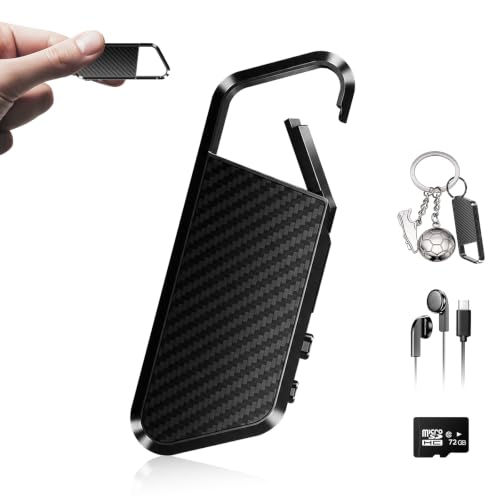
- 72GB storage rated for up to 10,860 hours
- DSP 6.0 noise reduction and voice activation
- OTG transfers to compatible mobile devices
Best For: Large lecture archives and long-term recording storage
Best All-Around Value – EVISTR L357 64GB Voice Recorder
For shoppers comparing voice recorders for lectures, the EVISTR L357 offers a practical mix of clear recording, simple controls, and long battery life. Its voice activation, adjustable gain, playback tools, and 64GB capacity make it suitable for regular classroom use.
Best For: Students and teachers who want straightforward lecture recording with voice activation and playback.
Pros:
- Records up to 1536kbps stereo audio with dynamic and PCM noise reduction.
- Voice activation and seven sensitivity levels can reduce silent sections.
- Offers up to 32 hours of continuous recording and 64GB of storage.
- Simple two-button operation, variable-speed playback, and USB-C file transfer.
Cons:
- Its advertised 64GB capacity is smaller than the 128GB options in this roundup.
- Voice activation requires choosing an appropriate sensitivity level for the room.
This is a well-rounded choice when ease of use matters more than advanced transcription. It records locally, supports Windows and Mac transfers, and includes useful playback controls for reviewing lectures.
Best for AI Notes – Pocket AI Voice Recorder
The Pocket takes a different approach to voice recorders for lectures by pairing one-tap recording with automatic transcription, summaries, and searchable AI insights. It is designed for users who want to turn spoken material into organized notes rather than only replay audio.
Best For: Students and professionals who want recorded conversations converted into summaries and action items.
Pros:
- One-tap recording captures meetings, calls, and in-person conversations.
- Can create transcriptions, summaries, action items, conversation maps, and mind maps.
- Ask Pocket lets users query information grounded in their recordings.
- Offers MagSafe compatibility and up to four days of battery life.
Cons:
- Additional premium features may require an optional subscription.
- Its smartphone-focused Bluetooth setup may be less direct than a standalone recorder with headphone playback.
The Pocket is most compelling when lecture review means skimming organized notes and asking questions about the material. Buyers should account for the optional subscription and smartphone-dependent workflow before choosing it over a traditional recorder.
Best for Maximum Storage – EVIDA 128GB Lecture Recorder
For buyers needing high-capacity voice recorders for lectures, the EVIDA recorder provides 128GB of storage and up to 54 hours of continuous recording. Its PCM recording, voice activation, password protection, and folder organization make it suited to frequent recording and long-term file storage.
Best For: Students, teachers, and professionals who need extensive local storage and organized recordings.
Pros:
- 128GB capacity stores up to 9,296 hours at the listed lower recording setting.
- Supports up to 1536kbps WAV recording plus MP3 settings.
- Voice activation offers six sensitivity levels to reduce blank sections.
- Includes password protection, four folders, bookmarks, playback, and USB file transfer.
Cons:
- The listed battery life is up to 54 hours, so it may require recharging during especially extended use.
- The details list no headphone jack, which may limit convenient private playback.
- Its feature set may take more setup than a basic two-button recorder.
This model stands out for storage and file-management features rather than AI processing. It is a strong fit for users who archive many lectures locally and value password protection and folder organization.
Best AI Recorder with Local Transfer – EVISTR L359 AI Voice Recorder
The EVISTR L359 combines a compact digital recorder with AI transcription and summarization, making it one of the more feature-rich voice recorders for lectures. It records up to 3072kbps, supports voice activation, and transfers files to a phone through a wired OTG connection for processing in the AI DVR Link app.
Best For: Students and professionals who want high-quality local recording plus multilingual transcription and summaries.
Pros:
- Supports transcription in 113 languages, summaries, mind maps, speaker identification, and Ask AI insights.
- Records up to 3072kbps with intelligent noise reduction and voice activation.
- 128GB storage can hold up to 9,216 hours at 32kbps.
- One-button recording, password encryption, HOLD switch, and wired OTG transfer.
Cons:
- AI processing depends on the AI DVR Link app and a compatible phone or computer workflow.
- Continuous recording is listed at up to 33 hours, shorter than the EVIDA option.
- Wired OTG transfer is secure and stable but less convenient than a wireless connection.
This is a strong choice for buyers who want more than playback and file storage. Its AI tools can streamline lecture review, while the recorder still provides local files, voice activation, and a physical HOLD switch.
Simple Lecture Recorder – Compact 16GB Voice Recorder
If you want straightforward voice recorders for lectures, this compact Sunlan model emphasizes simple one-button operation, clear mono recording, and easy playback. Its 16GB storage, noise-reduction technology, and voice-activated mode make it practical for classes, meetings, and interviews.
Best For: Students and casual users who want an uncomplicated recorder with playback, A-B repeat, and USB file transfer.
Pros:
- One-button recording with simple REC, STOP, and PLAY controls.
- Noise reduction and a sensitive built-in microphone help capture speech clearly.
- Voice activation can save recording time and reduce power consumption.
- Offers 16GB storage, up to 30 hours of recording, and a 3.5mm headphone jack.
Cons:
- Mono microphone operation is less suited to stereo or spatial recordings.
- Playback battery life is listed at about 7 hours.
- Its feature set is more basic than models with built-in transcription.
This is a sensible pick when ease of use matters more than advanced study tools. A-B repeat is especially useful for revisiting a key explanation, while the small 35-gram design is easy to carry between classes.
AI Study Recorder – iFLYTEK Offline Transcription Recorder
For shoppers comparing voice recorders for lectures, the iFLYTEK 302Pro stands out for offline speech-to-text in five languages. It combines multiple recording modes, six-microphone noise cancellation, bookmarks, and timeline playback for users who want to review or convert lectures into editable notes.
Best For: Students, language learners, and professionals who need offline transcription and extended battery life for classes, seminars, or meetings.
Pros:
- Transcribes speech offline in English, Chinese, Japanese, Korean, and Russian.
- Six-microphone AI noise cancellation is designed to reduce crowds and echoes.
- Offers intelligent, conference, interview, and speech recording modes.
- Provides smart bookmarks, timeline playback, USB importing, and exports to PDF, Word, or TXT.
Cons:
- Background noise and accents may affect transcription accuracy.
- There is no listed headphone jack.
- The device uses 8GB of storage, less than some high-capacity alternatives.
The 302Pro is the most feature-focused option here for turning spoken material into searchable study content. Its advertised 190-hour battery life suits long events, but users should keep the microphones unobstructed and fully charge the recorder before use.
High-Capacity Lecture Recorder – Tonfarb 136GB Digital Recorder
If recording capacity and battery endurance are priorities, this Tonfarb model is a strong option among voice recorders for lectures. It pairs PCM recording and automatic noise reduction with voice activation, one-click recording, and enough listed storage for extensive audio archives.
Best For: Students, journalists, and frequent meeting attendees who need long recording sessions and substantial file storage.
Pros:
- Supports 1536 kbps PCM recording with dual noise-reduction microphones.
- Includes 8GB built-in storage and a 128GB TF card, marketed as 136GB total capacity.
- Records continuously for up to 68 hours on its rechargeable battery.
- Provides one-click recording, voice activation, A-B repeat, password protection, and USB-C transfer.
Cons:
- Its 1.44-inch screen is smaller than the iFLYTEK model’s display.
- The supplied details do not list transcription or voice-to-text features.
- The advertised 9,775-hour capacity depends on MP3 recording and the included memory configuration.
This recorder is built for users who would rather avoid frequent charging or file management. Its metal casing and 97-gram weight keep it portable, while the physical recording switch allows quick capture even when the device is powered off.
Best Value for Students – HoTiyan 8GB Voice Recorder
If you want straightforward voice recorders for lectures, the HoTiyan 8GB model combines stereo recording, voice activation, and simple three-button controls. Its rechargeable battery supports up to 20 hours of continuous recording, while A-B repeat and variable playback speed are useful for reviewing class material.
Best For: Students who want an affordable, easy-to-operate recorder for lectures, meetings, and study review.
Pros:
- High-sensitivity stereo microphone with noise reduction.
- Voice activation can skip quieter sections and reduce wasted storage.
- A-B repeat, variable playback speed, and password protection support study use.
- Includes MP3 playback, a 3.5mm headphone jack, and Micro USB file transfer.
Cons:
- Built-in storage is limited to 8GB.
- Micro USB is less convenient than USB-C for newer devices.
- The listed recording capacity varies substantially by recording quality.
This is a practical pick if you prioritize simple controls and lecture-review features over maximum storage or the newest connection standard.
Best for Long Recording Sessions – Vandlion HD Voice Recorder
The Vandlion is one of the more capable voice recorders for lectures when battery life and audio detail matter. It records in 1536Kbps PCM HD audio with dual high-sensitivity microphones and AI noise reduction, and its one-touch slide control is designed for quick starts.
Best For: Users recording long lecture series, meetings, interviews, or other sessions where battery endurance and storage flexibility are priorities.
Pros:
- 100-hour battery supports extended recording between charges.
- 16GB internal memory can be expanded up to 256GB.
- One-touch recording, automatic timestamps, and USB-C transfer simplify daily use.
- Offers voice activation, A-B repeat, scheduled recording, and password protection.
Cons:
- Voice activation is off by default and requires manual setup.
- The supplied details list WAV as the recording format.
- At 65g, it is heavier than some ultra-compact recorders.
Choose this model if you expect frequent or lengthy recordings and want a durable, pocket-sized device with substantially more battery and expandable storage than basic recorders.
Best Simple Pick – NekSide 72GB Voice Recorder
For buyers who need to retain a large archive, the NekSide offers unusually high storage among voice recorders for lectures. Its 72GB memory is rated for up to 10,860 hours of audio, while DSP 6.0 noise reduction and voice activation are designed to help capture usable recordings in busy settings.
Best For: Users who record large numbers of lectures, interviews, meetings, or personal memos and want to minimize file deletion.
Pros:
- 72GB built-in storage provides extensive recording capacity.
- DSP 6.0 noise reduction is designed to filter background noise.
- OTG support enables direct transfers to compatible smartphones or tablets.
- Voice activation and playback are included for easier recording management.
Cons:
- Recordings default to WAV format; MP3 requires conversion on a computer.
- The built-in microphone operates in mono rather than stereo.
- The listed headphone interface is Mini-USB, which may be less familiar.
This recorder stands out primarily for storage and mobile transfer convenience, making it a strong fit for archival use if mono WAV recording meets your needs.
How We Picked the Best Voice Recorders for Lectures
We compared these models by focusing on the features that matter during real classes and presentations: recording reliability, microphone performance, storage, battery operation, playback convenience, portability, and available transcription tools. We also considered whether each recorder is best suited to straightforward audio capture or a more advanced workflow involving summaries and searchable notes.
Capacity claims can vary by recording quality and file format, so treat advertised hour totals as estimates rather than guarantees. For students, ease of use and dependable battery life are often more valuable than the largest headline storage number.
Quick Comparison
| Best for | Look for | Featured options |
|---|---|---|
| Simple lecture recording | One-touch controls, playback, and clear microphones | EVISTR, Vandlion, and 8GB recorder |
| Long-term storage | High capacity and voice activation | EVIDA 128GB, Tonfarb 136GB, and 72GB model |
| AI-assisted notes | Transcription, summaries, and noise reduction | Pocket AI, EVISTR AI, and iFLYTEK |
| Portable everyday use | Small design, rechargeable battery, and simple playback | 16GB upgraded recorder and Vandlion |
Key Buying Factors for Voice Recorders for Lectures
Microphone Quality and Recording Clarity
A recorder should capture the instructor clearly from your usual seating position. Noise reduction can help in busy rooms, but it cannot fully compensate for distance, poor placement, or an obstructed microphone. Stereo or improved microphone systems may be useful in larger classrooms and group discussions.
Storage and File Management
Choose enough space for your class schedule, then consider how easily files can be labeled, transferred, and deleted. High-capacity models are useful when you record frequently, while an 8GB or 16GB device may be sufficient for occasional lectures if you regularly move files to a computer.
Battery Life and Controls
Look for straightforward start, stop, pause, and playback buttons. Voice activation can reduce silent sections and conserve storage, but test its sensitivity before relying on it. USB charging is convenient; confirm the expected runtime and charging method before class.
Transcription, Privacy, and Compatibility
AI transcription and summaries can save time, particularly for revision, but check whether processing requires an app, internet connection, subscription, or account. Offline transcription may offer stronger privacy and work in more settings. Also confirm supported languages and whether recordings export in a widely compatible format.
Who Should Buy Which Voice Recorders for Lectures?
Students who want uncomplicated recording should prioritize a compact playback model such as an EVISTR, Vandlion, or basic 8GB/16GB device. Choose a high-capacity EVIDA, Tonfarb, or 72GB recorder if you capture many lectures and prefer not to transfer files often.
Buy an AI-enabled Pocket AI, EVISTR AI, or iFLYTEK recorder if turning speech into searchable text or summaries is central to your workflow. Researchers and interviewers should favor strong noise reduction, dependable file management, and generous battery life. Whichever model you choose, check your school or workplace rules and obtain permission before recording other people.