A docking station with 10GbE can turn a compatible laptop into a high-speed workstation, combining fast wired networking with displays, charging, storage, and everyday peripherals.
We selected 10 promising docks for 2026, ranging from compact USB-C hubs to advanced Thunderbolt 5 models. Use the guide below to match port selection, network performance, display support, and power delivery to your setup.
Best 10 Docking Station with 10gbe Picks for 2026
Top Thunderbolt 5 Pick

- 20-port Thunderbolt 5 dock with PCIe-based 10GbE
- Up to 140W host charging with a 330W power supply
- Dual USB controllers help reduce peripheral bottlenecks
Best For: High-performance Mac and Windows Thunderbolt workstations
Professional Connectivity Pick

- 10GbE, CFexpress Type B, and SD card connectivity
- Supports select 8K, 5K, and dual-4K display setups
- AVB-ready with up to 85W host power delivery
Best For: Creative production and professional media workflows
Flexible USB-C Value Pick

- 14-in-1 dock with data speeds up to 10Gbps
- Dual HDMI display support for compatible laptops
- 160W total output with high-powered USB-C charging
Best For: Windows USB-C laptop productivity setups
Mac Workstation Powerhouse

- 26-in-1 Mac dock with 10GbE networking
- Supports up to four 6K or two 8K displays on compatible Macs
- Four 80/120Gbps downstream USB-C ports and 140W PD
Best For: High-end M-series Mac multi-display workstations
Fleet-Ready DisplayLink Hub
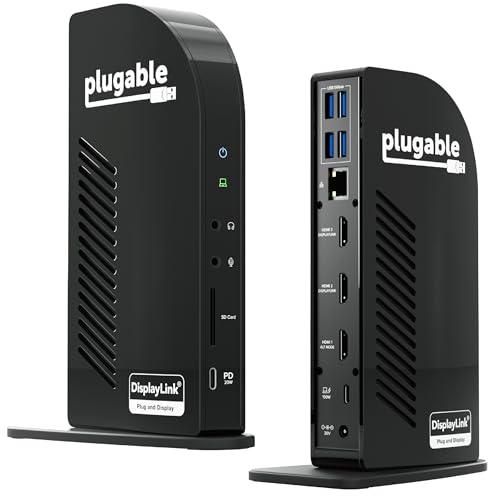
- 13 ports with three HDMI outputs and Gigabit Ethernet
- Up to 100W laptop and 20W device charging
- DisplayLink enables multi-monitor Mac setups
Best For: Office and home users prioritizing triple displays and standardized deployment
Network-First Workstation Dock

- Two independent 10GbE ports plus 2.5GbE
- Link aggregation can reach up to 20Gb/s to a NAS
- Supports up to three 8K displays and fanless operation
Best For: Thunderbolt 5 users with NAS, multi-network, or IP-based workflows
Compact Dual-Display Hub

- Dual 4K at 60Hz or single 4K at 120Hz on Windows
- 10Gbps USB-C and USB-A data connectivity
- Up to 85W laptop charging with SD/TF readers
Best For: Windows users wanting compact dual-display and fast USB expansion
Best Professional Workstation
Sonnet Echo 20 Thunderbolt 5 SecureDock
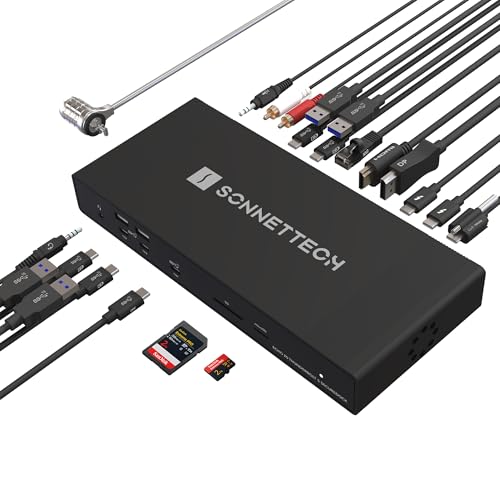
- Built-in 10GbE for fast NAS and network access
- 20 ports with nine 10Gbps USB connections
- Up to 140W charging and multi-display support
Best For: Professional desktop workstations needing 10GbE and extensive expansion
Best Compact Thunderbolt 5 Option
Anker Prime 14-in-1 Thunderbolt 5 Dock

- Thunderbolt 5 supports up to 120Gbps data transfer
- Up to 140W charging with PD 3.1
- 2.5Gbps Ethernet and active cooling
Best For: Thunderbolt 5 users prioritizing speed, displays, and compactness over 10GbE
Best Dual-HDMI Setup
Plugable Thunderbolt 5 Dock with Dual HDMI 2.1

- Dual HDMI 2.1 supports up to 8K60 or 4K144
- Six USB-C ports with two 30W charging ports
- 2.5GbE, 140W charging, and driverless setup
Best For: Office users needing dual HDMI displays and plentiful USB-C expansion
Top Thunderbolt 5 Pick – CalDigit TS5 Plus
The CalDigit TS5 Plus is a high-end docking station with 10GbE for users who need extensive connectivity, fast network transfers, and substantial laptop charging. Its Thunderbolt 5 platform pairs 20 ports with dual USB controllers to help manage multiple high-speed peripherals.
Best For: Thunderbolt 5 or USB4 users building demanding Mac or Windows workstations with 10GbE networking.
Pros:
- PCIe-based 10GbE supports faster transfers to compatible networks and NAS devices.
- Provides 20 ports, including Thunderbolt 5, USB, DisplayPort 2.1, card readers, and audio.
- Offers up to 140W host charging and includes a 330W power supply.
- Supports extensive high-resolution display configurations on compatible Macs.
Cons:
- Maximum functionality requires a Thunderbolt 5 or USB4 v2 host.
- Ethernet support requires a Thunderbolt host or a USB4 host with PCIe support.
The TS5 Plus is the strongest all-around choice here for bandwidth-heavy setups, but its advanced features are best matched with newer computers and demanding peripherals.
Professional Connectivity Pick – OWC Thunderbolt Pro Dock
The OWC Thunderbolt Pro Dock is a professional docking station with 10GbE designed for Mac and Windows systems using Thunderbolt 3 or higher. It combines a 10GbE port with CFexpress and SD card readers, high-speed USB ports, and display support up to 8K at 60Hz.
Best For: Creative professionals, photographers, and video or audio users who need fast networking and media-card connectivity.
Pros:
- Includes 10GbE, CFexpress Type B, and SD card slots.
- Supports up to one 8K display, one 5K display, or two 4K displays depending on the host.
- Provides 85W charging through one Thunderbolt 3 port and 15W through another.
- AVB-ready design suits professional audio and video applications.
Cons:
- Requires a Thunderbolt 3 or higher host connection.
- Its 10-port layout is less expansive than some newer multiport docks.
- HDMI display connections through Thunderbolt require a separate adapter.
This dock is a focused professional solution rather than an all-purpose port hub, making its strongest appeal the combination of 10GbE, media readers, and reliable Thunderbolt display support.
Flexible USB-C Value Pick – Anker Prime Docking Station
The Anker Prime is a practical docking station with 10GbE-oriented connectivity for compatible USB-C, USB4, and Thunderbolt laptops. Its 14-in-1 design combines up to 10Gbps data transfer, dual HDMI outputs, Ethernet, audio, and high total charging output.
Best For: Windows laptop users who want a broad USB-C dock with fast peripheral connectivity and dual-monitor support.
Pros:
- Offers 14-in-1 connectivity with data speeds up to 10Gbps.
- Supports dual HDMI displays up to 2K at 60Hz with a DP 1.4 laptop.
- Provides 160W total output, including USB-C ports rated up to 100W each.
- Works with compatible USB-C, USB4, and Thunderbolt connections.
Cons:
- Mac users receive identical images on both external monitors.
- It does not support Linux.
- It does not support a 5120×1440 monitor.
The Anker Prime is a versatile choice for everyday productivity, especially on Windows, though users seeking the highest-resolution displays or Linux support should consider another dock.
Mac Workstation Powerhouse – iVANKY FusionDock Ultra
The iVANKY FusionDock Ultra is a Mac-focused docking station with 10GbE for demanding multi-display and storage workflows. Its 26-in-1 design combines 10Gbps networking, multiple high-bandwidth downstream USB-C ports, extensive display support, card readers, and up to 140W power delivery.
Best For: MacBook Pro, Mac Studio, and Mac mini users building high-end multi-display production workstations.
Pros:
- Provides 10GbE and four dedicated 80/120Gbps USB-C downstream ports.
- Supports up to four 6K displays or two 8K displays on compatible M-series Macs.
- Includes 26 ports, SD 4.0, optical audio, HDMI, DisplayPort, and a 45W charging port.
- Uses active cooling, copper heatsinks, and a floating chassis for sustained performance.
Cons:
- It is designed exclusively for macOS and is incompatible with Windows.
- Display compatibility varies by Mac model, so users should review the compatibility guidance before buying.
- The feature-rich design weighs 2.76 kg.
For compatible Apple hardware, the FusionDock Ultra offers unusually broad display and high-speed expansion capabilities; its Mac-only design makes platform compatibility the key buying consideration.
Fleet-Ready DisplayLink Hub – Triple Monitor USB-C Dock
If you need a docking station with 10gbe for a standardized office or home setup, this Plugable model focuses on display expansion, charging, and broad laptop compatibility rather than 10GbE networking. Its 13 ports include three HDMI outputs, Gigabit Ethernet, USB connections, card readers, and audio.
Best For: Offices and home workstations that need triple-monitor support, centralized laptop charging, and enterprise-friendly deployment features.
Pros:
- Supports up to three extended HDMI displays through DisplayLink, including compatible Mac systems.
- Provides up to 100W laptop charging and 20W charging for front-connected devices.
- Offers 13 ports, TAA/NDAA/Section 889 compliance, and lifetime North American support.
Cons:
- Ethernet is Gigabit rather than 10GbE.
- DisplayLink Manager is required for multiple displays on macOS, and protected-content playback is unsupported.
- HDMI 1 reaches 4K at 30Hz, while HDMI 2 and 3 support up to 1920×1200 at 60Hz.
This is a strong productivity dock when monitor count and deployment consistency matter more than multi-gigabit networking. Buyers specifically seeking a docking station with 10gbe should consider a different model.
Network-First Workstation Dock – Dual 10GbE Thunderbolt 5 Dock
For shoppers specifically seeking a docking station with 10gbe, the OWC Thunderbolt 5 dock is the most network-focused option here. It combines two independent 10Gb/s Ethernet ports with a front 2.5Gb/s port, making it suitable for multi-network work and high-speed NAS access.
Best For: Professionals using NAS storage, AVB, Dante, NDI, 3D rendering, or multiple wired networks from a Thunderbolt 5 laptop or workstation.
Pros:
- Includes two independent 10GbE ports plus a separate 2.5GbE port.
- Supports link aggregation for NAS access of up to 20Gb/s, according to the supplied specifications.
- Offers Thunderbolt 5 connectivity, four USB 10Gb/s ports, three display support up to 8K at 60Hz, and fanless operation.
Cons:
- The Thunderbolt 5 host port does not charge the laptop; the original laptop power adapter must be connected separately.
- Compatibility is more specialized, with newer Thunderbolt, USB4, Windows, macOS, or supported Linux requirements.
- It is a 2-pound workstation-class dock rather than a lightweight travel hub.
This is the clearest match for demanding wired-network workflows. Its dual 10GbE ports and link-aggregation support distinguish it from conventional USB-C docks, though the lack of host charging should be planned for.
Compact Dual-Display Hub – 10Gbps USB-C Dock
This compact Baseus hub is worth considering if you want a small USB-C dock with fast peripheral ports and dual-display support. It is not a docking station with 10gbe networking: its Ethernet port is listed without a 10GbE specification, while the 10Gbps rating applies to select USB data ports.
Best For: Windows laptop users who need dual 4K displays, fast USB transfers, card readers, and up to 85W laptop charging in a compact enclosure.
Pros:
- Supports dual 4K displays at 60Hz, with single-display output up to 4K at 120Hz on Windows.
- Includes USB-C and USB-A data ports rated up to 10Gbps, plus SD and TF card readers.
- Accepts up to 100W USB-C PD input and delivers up to 85W to the laptop.
Cons:
- macOS supports mirrored rather than independently extended content across two monitors.
- Power adapter and input cable are not included.
- The supplied notes do not identify the Ethernet port as 10GbE.
The Baseus is a practical, portable expansion hub for displays and USB peripherals, especially on Windows. Choose it for compact connectivity and USB 10Gbps transfers, not for 10-gigabit Ethernet.
Best Professional Workstation – Sonnet Echo 20 Thunderbolt 5 SecureDock
If you need a docking station with 10gbe for demanding professional workflows, the Sonnet Echo 20 Thunderbolt 5 SecureDock combines ultra-fast networking with extensive expansion. Its 10GbE port, 20 interfaces, 140W charging, and support for high-resolution displays make it suited to a full desktop setup built around a compatible Thunderbolt host.
Best For: Professionals connecting NAS storage, multiple displays, high-speed peripherals, and a laptop through one workstation dock.
Pros:
- Built-in 10GbE supports fast network connections over Cat6 or Cat6A cabling.
- Thunderbolt 5 provides up to 80Gbps bidirectional data bandwidth and up to 120Gbps video bandwidth.
- Offers 20 interfaces, including nine 10Gbps USB ports, HDMI, DisplayPort, and UHS-II SD and microSD readers.
- Up to 140W Power Delivery supports single-cable laptop charging.
Cons:
- At 2.9 pounds and nearly 10 inches long, it is more workstation-oriented than travel-friendly.
- Full display and Thunderbolt 5 capabilities depend on the host computer and operating system.
The Echo 20 is the clearest fit when 10GbE networking is a priority rather than an add-on. It is a substantial investment in connectivity, but its broad port selection and display support can replace several separate adapters.
Best Compact Thunderbolt 5 Option – Anker Prime 14-in-1 Thunderbolt 5 Dock
The Anker Prime is a compact Thunderbolt 5 docking station with 10gbe-style high-speed connectivity needs in mind, though its wired Ethernet port is rated at 2.5Gbps rather than 10Gbps. It focuses on fast Thunderbolt transfers, dual-display capability, strong charging, and active cooling in a relatively small enclosure.
Best For: Thunderbolt 5 laptop users who want a compact dock for fast storage, dual displays, Ethernet, and high-power charging.
Pros:
- Thunderbolt 5 connectivity supports up to 120Gbps maximum data transfer and fast large-file handling.
- Supports one HDMI or DisplayPort connection plus two Thunderbolt video outputs, including up to dual 8K at 60Hz on compatible Windows laptops.
- Provides up to 140W upstream charging with PD 3.1 support.
- Active cooling is designed to help maintain performance under full load.
Cons:
- Its Ethernet port is 2.5Gbps, so it does not meet the full speed of a true 10GbE docking station.
- Compatibility is focused on newer Thunderbolt 5/4 systems and specified macOS versions.
This dock is a strong alternative for buyers who prioritize Thunderbolt 5 throughput and a compact design over 10GbE networking. If your network requires 10GbE specifically, plan on using a separate adapter or choosing a dock with built-in 10GbE.
Best Dual-HDMI Setup – Plugable Thunderbolt 5 Dock with Dual HDMI 2.1
The Plugable TBT-UDH2 is a practical choice for users comparing a docking station with 10gbe against a display-focused model. It does not include 10GbE—it uses 2.5Gbps Ethernet—but it delivers dual native HDMI 2.1, six USB-C connections, 140W laptop charging, and driverless operation for supported Thunderbolt systems.
Best For: Hybrid workers and IT deployments that need dual HDMI displays, plentiful USB-C ports, and simple plug-and-play operation.
Pros:
- Dual HDMI 2.1 outputs support up to 8K at 60Hz or 4K at 144Hz with Thunderbolt 5 hosts.
- Six USB-C connections include two front-facing ports with up to 30W charging each.
- Provides 140W laptop charging, 2.5Gbps Ethernet, and UHS-II card readers.
- Fanless, driverless, and TAA compliant, with lifetime support from Plugable’s North American team.
Cons:
- Its 2.5Gbps Ethernet port is not a substitute for built-in 10GbE.
- Compatibility excludes Thunderbolt 3, USB-C, Windows ARM, and certain gaming-laptop configurations.
- Display support varies by host processor and operating system.
The TBT-UDH2 makes sense when dual HDMI output and USB-C expansion matter more than 10GbE networking. It is especially appealing for a clean office setup, but buyers with a 10GbE NAS or network should verify whether a separate network adapter will be needed.
How We Picked the Best Docking Station with 10gbe
We focused on docks that support 10GbE networking directly or are designed for high-speed connectivity through modern Thunderbolt and USB-C standards. We also considered port variety, charging capacity, display support, operating-system compatibility, physical design, and the needs of home offices, creative workstations, and professional networks.
Because advertised specifications can depend on the host computer, cable, operating system, and connected display, check the manufacturer’s compatibility details before buying. A Thunderbolt 5 dock may offer excellent expansion, but it cannot make a laptop exceed the capabilities of its own ports.
Quick Comparison
| Best For | What to Prioritize |
|---|---|
| Maximum expansion | 20-plus ports, multiple video outputs, and strong power delivery |
| Thunderbolt 5 systems | Thunderbolt 5 bandwidth, 10GbE, and high-resolution display support |
| Mac or Windows flexibility | Broad OS compatibility and clearly documented display support |
| Simple dual-monitor desks | Two HDMI or DisplayPort outputs, USB accessories, and dependable charging |
| Portable setups | Compact construction, a manageable power adapter, and essential ports |
Key Buying Factors for a Docking Station with 10gbe
Network Hardware and Real-World Speed
Confirm that the dock includes a true 10GbE port rather than ordinary Gigabit Ethernet or a “10Gbps” USB claim. Full performance also requires a 10GbE switch, router, cabling, and network storage or server that support the same standard. Thermal design and driver support can affect sustained transfers.
Host Connection and Bandwidth
Thunderbolt 4 and Thunderbolt 5 generally provide more consistent bandwidth for several demanding peripherals than basic USB-C. Check whether your laptop supports Thunderbolt, USB4, or only USB-C, and verify which features remain available at each connection level.
Displays and Charging
Look at the number and type of video outputs, maximum resolution and refresh rate, and whether your operating system supports the intended monitor arrangement. Power delivery matters too: high-wattage docks are useful for performance laptops, but the computer may accept less than the dock’s maximum output.
Port Layout and Compatibility
Count the ports you will use every day, including USB-A, USB-C, audio, card readers, and storage connections. Also check macOS display limitations, Windows driver requirements, included cables, warranty coverage, and the dock’s desk footprint.
Who Should Buy Which Docking Station with 10gbe?
Choose a premium Thunderbolt 5 model if you use a newer laptop, fast external storage, high-resolution monitors, or demanding professional workloads. A feature-rich 10GbE dock is best for creators, engineers, developers, and anyone moving large files to network storage.
For a conventional office with one or two monitors, a simpler USB-C or Thunderbolt dock may be the better value, especially if your network is limited to 1GbE. Choose a compact model for occasional travel or hot-desking, and select a high-power option when you need to charge a workstation laptop while running multiple peripherals.