A laptop can become the center of a much more capable desk setup with the right dock. The best docking stations with DisplayLink let compatible computers drive multiple external displays while adding ports for storage, networking, peripherals, and charging.
This roundup compares 10 options across dual-, triple-, and quad-monitor configurations, including USB-A and USB-C designs, high-wattage charging, and support for modern Mac and Windows laptops. Use the guide below to narrow your choice by display needs, compatibility, desk setup, and budget.
Best 10 Docking Stations with Displaylink Picks for 2026
Best Budget Dual-Display Pick
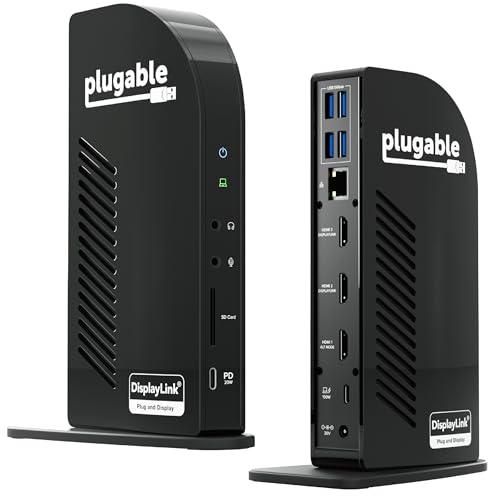
Plugable UD-3900 DisplayLink Dock

- Dual HDMI output up to 1920x1200 at 60Hz
- Gigabit Ethernet, audio, and six USB ports
- Two-year coverage with lifetime support
Best For: Everyday office productivity with two HD monitors
Best for Broad OS Compatibility
WAVLINK Triple-Monitor DisplayLink Dock

- Triple-monitor support up to 4K@60Hz
- Six 10Gbps USB Gen2 ports and gigabit Ethernet
- Up to 100W laptop charging with a 160W adapter
Best For: Mac and Windows users building a fast triple-monitor workstation
Best for Four-Display Workstations

- Supports up to four 4K@60Hz displays
- 20 ports with HDMI, DisplayPort, USB, Ethernet, and card readers
- Up to 100W laptop charging
Best For: Professionals building expansive, high-resolution multitasking setups
Best for Office Triple-Monitor Setups
WAVLINK 15-in-1 DisplayLink Dock

- Supports up to three monitors
- Includes five USB ports, Ethernet, SD/TF, and audio
- Up to 100W Power Delivery
Best For: Office productivity, spreadsheets, dashboards, and business workflows
Best for Business Deployment
Plugable Triple HDMI DisplayLink Dock
- Supports three extended HDMI displays
- 100W laptop and 20W accessory charging
- TAA, NDAA, and Section 889 compliant
Best For: Managed office, education, government, and home-office setups
Best for Triple-Screen Workstations
Triple-Display DisplayLink Dock

- Up to 4K + 2K + 2K at 60Hz
- 100W charging with 10Gbps USB ports
- Gigabit Ethernet and broad USB-C compatibility
Best For: Home offices and three-monitor productivity setups
Best Compact Hub Value
Compact Dual-HDMI DisplayLink Dock

- Dual HDMI display expansion in a small hub
- Gigabit Ethernet and SD/microSD readers
- Three USB 3.0 ports with up to 5Gbps transfer
Best For: Travel and compact multi-display workspaces
Best Dual-4K Flexibility

- Two 4K 60Hz monitor support
- Four HDMI/DisplayPort output options
- Six USB 3.0 ports plus Ethernet and audio
Best For: Dual-monitor offices with mixed laptop connections
Best for Multi-Monitor Workstations – Triple/Quad 4K DisplayLink Dock
If you need docking stations with displaylink for a demanding office or trading setup, the TobenONE combines extensive connectivity with support for up to three or four extended displays, depending on the computer and operating system. Its included 120W adapter also simplifies laptop and dock power management.
Best For: Stock traders, content creators, developers, and professionals building a multi-monitor workstation.
Pros:
- 18 ports, including three HDMI and three DisplayPort outputs.
- Supports triple or quad 4K@60Hz extended displays in compatible Windows setups; macOS supports up to three.
- Includes a 120W adapter and provides up to 100W laptop charging.
- Offers 10Gbps USB data transfer and gigabit Ethernet.
Cons:
- Requires DisplayLink drivers, including Screen Recording permission on macOS.
- Does not support Linux or Unix systems.
- Designed for productivity rather than high-refresh-rate gaming.
The TobenONE is a strong choice when display count, charging capacity, and port variety matter more than gaming-focused performance. Check your laptop’s video-output support and operating-system limits before buying.
Best Budget Dual-Display Pick – Plugable UD-3900 DisplayLink Dock
The Plugable UD-3900 is a practical entry point for docking stations with displaylink when your workspace needs two HDMI monitors and everyday peripheral connectivity. It uses a USB 3.0 or USB-C host connection and focuses on office productivity rather than high-resolution media or gaming.
Best For: Windows, Mac, and ChromeOS users who need dual HD monitors, Ethernet, audio, and extra USB ports.
Pros:
- Supports two HDMI displays up to 1920×1200 at 60Hz.
- Provides gigabit Ethernet, audio connections, two USB 3.0 ports, and four USB 2.0 ports.
- Includes a hybrid USB 3.0 and USB-C cable for flexible host compatibility.
- Backed by two-year coverage and lifetime support.
Cons:
- Does not support 4K displays or DisplayPort connections.
- Does not charge the host laptop.
- Not intended for gaming, HDCP-protected content, or streaming services such as Netflix.
This dock makes sense for a straightforward dual-monitor office setup, especially if your laptop already has its own charging solution. Its resolution ceiling and lack of host charging make it less suitable for modern high-resolution workstations.
Best Premium Windows Dock – Anker Prime DL7400 DisplayLink Dock
The Anker Prime DL7400 is a premium option among docking stations with displaylink, pairing triple 4K monitor support with fast USB connectivity, 2.5Gbps Ethernet, card readers, and a built-in smart display. It is designed specifically for USB-C Windows laptops and requires the latest DisplayLink driver.
Best For: Windows professionals who want triple 4K displays, high-speed storage connections, and a feature-rich desktop dock.
Pros:
- Supports three external 4K displays through two HDMI ports and one DisplayPort.
- Provides 14 connections, including 10Gbps USB-C, 5Gbps USB, 2.5Gbps Ethernet, SD, and TF card slots.
- Offers up to 140W laptop power through the upstream port.
- Smart display, built-in fan, and ActiveShield 3.0 help monitor and manage operation.
Cons:
- Compatible devices are USB-C Windows laptops; the latest DisplayLink driver is required.
- Front USB-C ports do not support USB-C or Thunderbolt monitor output.
- DRM-protected streaming may show a black screen through DisplayLink.
The DL7400 stands out for users who need more than display expansion, particularly fast networking and media-card access. Confirm Windows compatibility and use the included USB-C 3.2 Gen 2 cable for the intended performance.
Best for Broad OS Compatibility – WAVLINK Triple-Monitor DisplayLink Dock
The WAVLINK USB-C dock is a versatile choice among docking stations with displaylink for compatible Mac, Windows, ChromeOS, Android, and Harmony OS systems. It supports three monitors at up to 4K@60Hz, adds six 10Gbps USB ports, and includes a 160W power adapter for a well-equipped workstation.
Best For: Mac and Windows users who want triple-monitor productivity with fast USB connectivity and laptop power delivery.
Pros:
- Supports up to three 4K@60Hz monitors in compatible configurations.
- Includes six USB Gen2 ports rated for up to 10Gbps data transfer.
- Provides up to 100W laptop charging with the included 160W adapter.
- Supports a wide range of operating systems and laptop families, including Apple silicon Macs.
Cons:
- DisplayLink drivers are required before use.
- Its HDMI Alt Mode port requires a USB-C host port with video output support.
- Not supported with Unix, Linux, or iPadOS.
This WAVLINK model offers a useful balance of display expansion, charging, and high-speed peripheral support. Because monitor behavior depends on host-port capabilities and operating-system limits, verify your laptop’s USB-C specifications before ordering.
Best for Four-Display Workstations – Quad 4K DisplayLink Dock
For demanding multitasking setups, this docking station with DisplayLink combines four HDMI outputs, four DisplayPort outputs, and 20 total ports. It can drive up to four 4K@60Hz monitors on compatible Windows systems and Macs, though M1 MacBooks are limited to three extended displays. DisplayLink driver installation is required.
Best For: Professionals who need four external monitors, extensive peripheral connectivity, and high-resolution productivity displays.
Pros:
- Supports up to four 4K@60Hz external displays.
- 20-in-1 design includes USB, Ethernet, card readers, audio, HDMI, and DisplayPort connections.
- Provides up to 100W laptop charging and up to 18W USB-C phone charging.
- Includes a 150W power adapter, power button, two-year defect coverage, and long-term technical support.
Cons:
- DisplayLink drivers must be installed before use.
- HDCP is not supported.
- M1 MacBooks support up to three extended monitors rather than four.
This is the most capable option here for a large, high-resolution desktop, especially when you need many ports alongside quad-monitor support. Confirm your laptop’s charging and display compatibility before buying.
Best for Office Triple-Monitor Setups – WAVLINK 15-in-1 DisplayLink Dock
This WAVLINK docking station with DisplayLink is built for office productivity, offering three HDMI ports, two DisplayPort ports, fast USB connections, Ethernet, card readers, and audio. It supports up to three monitors on compatible Windows and Mac laptops, with up to dual 2K@60Hz through the primary HDMI/DisplayPort channels. A DisplayLink driver is required.
Best For: Office users managing spreadsheets, dashboards, reports, web applications, and other productivity workloads across multiple screens.
Pros:
- 15-in-1 connectivity includes three HDMI ports, two DisplayPort ports, five USB ports, Ethernet, SD/TF, and audio.
- Supports triple-monitor expansion on compatible Windows and Mac laptops.
- Delivers up to 100W Power Delivery with the included 130W adapter.
- Includes USB ports rated up to 10Gbps and SD/TF transfer speeds up to 104MB/s.
Cons:
- Requires DisplayLink driver installation and is not plug-and-play.
- Recommended primarily for office productivity rather than gaming or professional video editing.
- HDMI and DisplayPort connections on the same display channel cannot be used simultaneously.
Choose this dock when practical office connectivity matters more than maximum gaming or editing performance. Its mix of triple-display support, wired networking, storage readers, and fast USB ports suits a business-focused desk.
Best for Business Deployment – Plugable Triple HDMI DisplayLink Dock
For a standardized office setup, this USB-C docking station with DisplayLink provides 13 ports, triple HDMI output, 100W laptop charging, and 20W charging for connected devices. It supports extended displays on Windows, macOS, and ChromeOS systems with compatible USB-C, USB4, or Thunderbolt ports. DisplayLink Manager installation is required for multi-monitor use on macOS.
Best For: Businesses, schools, government deployments, and home offices that need consistent triple-monitor connectivity and broad laptop compatibility.
Pros:
- Supports up to three extended HDMI displays, with up to 4K@30Hz on HDMI 1.
- Provides up to 100W laptop charging and 20W front USB-C device charging.
- Includes three HDMI ports, four USB-A 5Gbps ports, SD, Gigabit Ethernet, and audio connectivity.
- Offers TAA, NDAA, and Section 889 compliance plus lifetime support.
Cons:
- Secondary HDMI outputs are limited to up to 1920×1200 at 60Hz.
- macOS requires DisplayLink Manager, and HDMI 2 and 3 need the driver for Mac use.
- Does not support protected-content playback such as Netflix or Hulu.
This Plugable model is a strong fit where repeatable deployment, support, and compatibility matter. Its display resolutions are more modest than a quad-4K dock, but its port selection and compliance features are well suited to managed work environments.
Best for Triple-Screen Workstations – Triple-Display DisplayLink Dock
If you need docking stations with DisplayLink for a demanding home office or mixed-device workspace, this WAVLINK model is built around a three-monitor setup. It supports one 4K 60Hz display plus two 2K 60Hz displays, while also providing 100W laptop charging, 10Gbps USB connectivity, and Gigabit Ethernet.
Best For: Home-office multitasking, coding, stock dashboards, online learning, and teams deploying multiple USB-C workstations.
Pros:
- Supports up to 4K + 2K + 2K across three external monitors.
- Provides 100W Power Delivery and includes a 130W power adapter.
- Six USB ports support 10Gbps transfers, with Gigabit Ethernet for stable networking.
- Works with many USB-C, USB4, and Thunderbolt 3/4 laptops, including newer Macs.
Cons:
- DisplayLink driver installation is required for Mac video output.
- The host USB-C port must support video output.
- Not recommended for gaming or HDCP-protected 4K streaming.
This is the most capable option here for users who want three screens, substantial charging, and fast peripheral connectivity in one desk setup. Confirm your laptop’s USB-C video support before buying.
Best Compact Hub Value – Compact Dual-HDMI DisplayLink Dock
Among docking stations with DisplayLink, this compact Giq hub emphasizes portability and basic expansion rather than laptop charging. It offers dual HDMI display connectivity, three USB 3.0 ports, Gigabit Ethernet, and SD and microSD card readers for travel or smaller workspaces.
Best For: Travelers, compact desks, MacBook and Chromebook users, and anyone needing displays plus card-reader access in a small hub.
Pros:
- Compact aluminum-and-plastic design measures about 2 by 2 by 0.59 inches.
- Combines dual HDMI output with three USB 3.0 ports and Gigabit Ethernet.
- Includes SD and microSD card readers for transferring media and files.
- Supports Windows, macOS, Chrome OS, Ubuntu, and Android systems listed by the manufacturer.
Cons:
- The USB-C port is for charging the hub and does not charge the laptop.
- USB data transfer is limited to up to 5Gbps.
- SD and microSD cards cannot be used simultaneously.
This hub makes sense when portability and card access matter more than high-speed USB or Power Delivery. Its charging limitation is important for buyers seeking a single-cable laptop-charging dock.
Best Dual-4K Flexibility – Dual-4K DisplayLink Dock
For buyers comparing docking stations with DisplayLink for a two-monitor office, this WAVLINK dock supports up to two 4K displays at 60Hz. Its four video outputs allow dual HDMI, HDMI plus DisplayPort, or dual DisplayPort configurations, and it works with USB-A, USB-C, USB4, and Thunderbolt laptops.
Best For: Remote workers and office users who need flexible dual-4K monitor connections across different laptop ports.
Pros:
- Supports up to two 4K 60Hz external monitors on compatible systems.
- Offers flexible HDMI and DisplayPort combinations.
- Works with USB-A, USB-C, USB4, and Thunderbolt 3/4/5 laptops.
- Includes six USB 3.0 ports, Gigabit Ethernet, and a 3.5mm audio jack.
Cons:
- DisplayLink driver installation is required for video output.
- It does not provide laptop charging.
- Not compatible with Linux systems and is not designed for gaming or DRM-protected streaming.
This model is a practical choice for dual-screen productivity when port flexibility is a priority. Plan to keep your laptop charger connected separately, since the dock provides connectivity but no Power Delivery.
How We Picked These Docking Stations with Displaylink
We selected models that offer practical multi-monitor expansion through DisplayLink, with attention to the number and type of video outputs, advertised resolution and refresh-rate support, host connectivity, power delivery, and broader port selection. The list includes compact dual-display docks, triple-monitor options, and higher-capacity models designed for demanding workstations.
Compatibility is especially important. DisplayLink docks typically require software or drivers, and support can vary by operating system, laptop chipset, macOS version, and connected display arrangement. Before buying, confirm the manufacturer’s compatibility information for your exact computer.
Quick Comparison
| What to compare | Best fit |
|---|---|
| Dual-monitor output | Home offices, productivity, and smaller desks |
| Triple-monitor output | Multitasking, finance, coding, and content workflows |
| Quad-monitor output | Large workstations and specialized monitoring setups |
| Higher power delivery | USB-C laptops that need charging through one cable |
| USB 3.0 host connection | Older laptops or systems without USB-C video expansion |
Key Buying Factors for Docking Stations with Displaylink
Display Count and Resolution
Choose based on the number of screens you will use now, not only the maximum listed by the dock. Check whether the advertised resolution applies to every display simultaneously, and verify that the outputs match your monitors. HDMI and DisplayPort combinations may require adapters.
Host Connection and Compatibility
USB-C docks are convenient for newer laptops, but the USB-C port must support the required data connection. USB-A models can work with older systems, although they may have different display, charging, and bandwidth limitations. Mac users should also confirm how their specific Apple silicon model handles multiple external displays through DisplayLink.
Power Delivery and Ports
Compare the dock’s charging wattage with your laptop’s requirements. A high advertised figure does not always mean the computer receives that amount after powering the dock and connected accessories. Also count the ports you actually need, such as USB-A, USB-C, Ethernet, SD or microSD, audio, and extra display outputs.
Drivers, Updates, and Desk Reliability
DisplayLink software is central to operation, so look for current driver support and clear setup instructions. Consider the included power adapter, cable length, heat management, and whether the dock can remain connected to your monitors and accessories without frequent reconnects.
Who Should Buy Which Docking Stations with Displaylink?
Choose a dual-display model if you mainly need email, documents, spreadsheets, and browser windows across two monitors. A triple-display dock is a stronger choice for intensive multitasking or a permanent workstation. If you manage several dashboards or need a large visual canvas, a quad-display model may justify its extra size and cost.
Prioritize higher-wattage USB-C charging when you want a one-cable laptop setup. Choose a USB 3.0 dock when compatibility with an older laptop matters more than maximum bandwidth. For MacBook owners, focus first on confirmed DisplayLink support for the exact model and macOS version, then compare outputs and charging. Windows users should likewise verify driver support and available USB bandwidth before connecting several high-resolution displays.